Views: 0 Author: Site Editor Publish Time: 2026-05-20 Origin: Site
For DTC streetwear and casual apparel brands, China vs Vietnam vs India apparel sourcing 2026 decisions directly impact margins, speed-to-market, compliance risk and long-term supply chain resilience. With shifting U.S. tariffs, rising labor costs in traditional hubs, and growing demand for customization and smaller runs, pure single-country strategies are increasingly risky.
Brands that treat sourcing as a strategic, data-backed process — rather than a simple price hunt — are better positioned to protect margins while scaling. This guide delivers a production-floor perspective with quantifiable benchmarks on cost, lead time, compliance and DTC-specific capabilities (custom prints, heavyweight knits, low-MOQ flexibility).
Tariff volatility, wage inflation and geopolitical factors have made diversification (“China +1” or multi-country) a priority for DTC founders and procurement teams. China remains unmatched in speed and ecosystem depth, but effective landed costs have risen sharply for U.S. market brands. Vietnam has emerged as a strong volume alternative with improving infrastructure, while India offers the lowest base costs alongside growing sustainability credentials (especially organic cotton and hand embellishments).
The winning approach in 2026 is rarely “all in one country.” It is a calibrated mix based on product type, order volume, margin targets and risk tolerance.
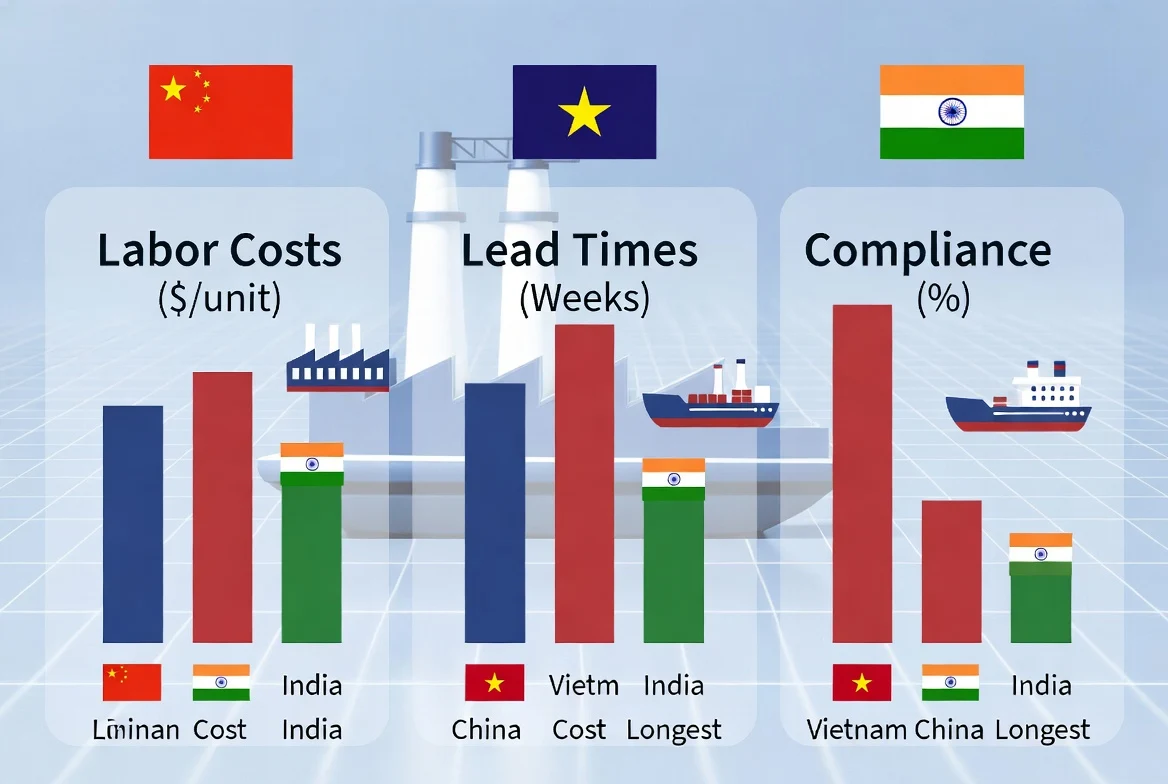
Labor typically represents 15–30% of FOB cost in apparel, with fabric and trims making up the majority. However, tariffs and logistics often swing the final landed cost more than base production differences.
2026 Labor Cost Benchmarks (apparel/garment sector, USD):
China: $5.5–6.5 per hour (coastal factories higher). Monthly garment worker compensation often $520–1,000+ including benefits/overtime.
Vietnam: $2.5–3.5 per hour. 2026 minimum wage increase (~7%) brings regional minima to roughly $141–202/month. Average garment earnings with overtime ~$385–577.
India: $1.5–2.5 per hour. Lowest base labor cost, though productivity and management intensity vary widely by region and factory.
Key production realities from the factory floor:
Vietnam often delivers 10–20% lower labor contribution than China for standard knits, but material imports (frequently from China) can add 5–10% effective cost and time.
India can show 15–30% lower base FOB on simple or embellished styles, yet higher rework rates on complex streetwear can erode part of the advantage.
For a typical custom heavyweight hoodie or fleece (300–380+ GSM), pre-tariff FOB differences are often in the 10–25% range, with Vietnam frequently the sweet spot for U.S. DTC brands once tariffs are included.
Tariff note (2026): China continues to face the highest effective duties on many apparel categories due to ongoing Section 301 and related measures. Vietnam and India generally operate under standard MFN rates (subject to specific HTS codes and any reciprocal adjustments). This gap frequently makes Vietnam the lower landed-cost option for U.S. market DTC brands despite slightly higher base production costs than India in some categories. Always verify current rates — policy remains fluid.
DTC brands live or die by drop cadence and reaction speed. Here China retains a clear edge.
Typical timelines (custom streetwear/knit orders):
China: Samples 7–14 days; bulk production 15–30 days (sometimes faster with stock fabric). Total door-to-door to U.S. West Coast often 35–60 days.
Vietnam: Production 25–45 days. Shipping 20–30+ days. Total frequently 50–80 days.
India: Production 35–60+ days common. Shipping 25–40+ days. Total often 65–100+ days, with greater variability due to inland logistics.
Why the difference matters for DTC:China’s vertically integrated clusters (fabric → printing/embroidery → sewing → finishing) minimize handoffs. This translates to fewer approval cycles and lower risk of delays on complex prints, washes or technical finishes common in streetwear. Vietnam and India have improved dramatically but still rely more on imported materials and face occasional port/infrastructure friction.
For limited-drop or testing collections, the speed advantage in China can outweigh modest cost differences.
All three countries face heightened scrutiny, especially on forced labor (UFLPA for U.S. importers) and traceability.
China: Mature audit infrastructure but highest regulatory attention. Strong capability for GOTS, OEKO-TEX, and detailed traceability when required. Many factories maintain robust SEDEX/BSCI systems.
Vietnam: Large number of WRAP, BSCI and SEDEX-certified facilities. Improving rapidly on transparency. Good for brands prioritizing documented compliance.
India: More fragmented. Strong on organic cotton and certain sustainability claims, but requires careful factory selection and auditing. Growing number of compliant exporters.
Practical takeaway: Budget for third-party audits and ongoing monitoring regardless of country. Multi-country programs increase complexity but also spread risk. Experienced partners who coordinate audits across sites deliver significant operational relief.
DTC success often hinges on low-to-medium MOQ flexibility, custom printing/embroidery, fabric development and consistent quality on smaller runs.
China excels at technical streetwear: heavyweight fleece, complex DTG/screen prints, custom trims, fast sampling and low MOQ (many factories now comfortable at 100–300 pcs per colorway for established DTC clients). Highest consistency on detailed or technical styles.
Vietnam strong for volume basics, sportswear and reliable mid-tier quality. Customization improving; best when designs are not overly complex.
India competitive for embellished or hand-finished looks and sustainable cotton programs. MOQ can be flexible, but quality consistency and development speed require strong factory partnerships.
MOQ reality check (2026): Leading factories across all three countries have lowered thresholds for DTC brands. Stock fabric programs and modular production enable smaller test runs, though true 50–100 pc orders still favor partners with dedicated small-batch capabilities.
| Dimension | China | Vietnam | India | Winner for DTC Streetwear |
|---|---|---|---|---|
| Labor Cost (USD/hr) | 5.5–6.5 | 2.5–3.5 | 1.5–2.5 | India |
| Typical Landed Cost (US market, tariff-adjusted) | Highest | Often lowest | Competitive on simple styles | Vietnam |
| Production Lead Time | 15–30 days | 25–45 days | 35–60+ days | China |
| Total Lead Time (to US) | 35–60 days | 50–80 days | 65–100+ days | China |
| MOQ Flexibility (DTC) | High (100–500 pcs common) | Medium–High | Medium–High | China |
| Customization & Prints | Excellent | Good | Good (esp. embellishment) | China |
| Supply Chain Integration | Best (local fabrics/trims) | Good (import dependent) | Moderate | China |
| Compliance Maturity | High (high scrutiny) | Good & improving | Improving (select factories) | Vietnam/China |
| Best Fit | Premium quality, fast drops, complex tech | Volume + tariff optimization | Cost + sustainable/embellished | — |
Benchmarks synthesized from 2025–2026 industry data and production comparisons. Actual results vary by style, factory and current trade policy.
Choose primarily China when:
You need fastest samples-to-bulk and highest consistency on technical or printed streetwear.
Order volumes support premium positioning and you value iteration speed.
You can absorb higher base costs or offset via efficiency/quality.
Choose primarily Vietnam when:
U.S. market focus and tariff sensitivity are high.
You want strong balance of cost, compliance and scalable quality for knits and sportswear.
You plan steady volume programs.
Choose India (or India + others) when:
Lowest base cost is critical and styles suit local strengths (cotton, embellishment, certain sustainable programs).
You have strong QC oversight or partner support.
Recommended 2026 approach for most DTC brands: Hybrid model. Use China for hero products, sampling and fast drops; Vietnam for core volume replenishment; India for specific sustainable or cost-optimized lines. This spreads risk and captures the best of each ecosystem.
Q: Can MOQ be lower than 300–500 pcs for custom heavyweight hoodies?A: Yes. Many factories now support 100–300 pcs per colorway using stock fabrics or modular production, especially for DTC brands with ongoing relationships.
Q: How much do tariffs really change the math between China and Vietnam?A: Significantly for U.S. imports. China’s higher effective duties often make Vietnam the lower landed-cost option even when base FOB is 10–15% higher. Always model current HTS rates.
Q: Which country offers the best compliance documentation for U.S. DTC brands?A: Vietnam currently presents a strong profile with widespread third-party certifications. China offers excellent traceability systems but faces greater regulatory scrutiny. India requires careful factory-level verification.
Q: Is multi-country sourcing too complicated for a growing DTC brand?A: It adds coordination complexity, but the risk reduction and margin optimization are substantial. The key is partnering with a manufacturer experienced in cross-border coordination rather than managing multiple suppliers independently.
Q: How do lead times affect inventory and cash flow for DTC drops?A: Longer lead times (Vietnam/India) require earlier forecasting and higher safety stock. China’s speed supports leaner inventory and faster reaction to trends — a major advantage for limited drops.
Single-country sourcing is no longer the lowest-risk or highest-margin path for most DTC apparel brands. The brands that will outperform are those that build intelligent multi-country portfolios — leveraging China’s speed and quality ecosystem, Vietnam’s cost-tariff balance, and India’s emerging strengths — while maintaining unified quality and compliance standards.
Achieving this level of sophisticated, data-driven multi-country sourcing requires more than spreadsheets. It demands a manufacturing partner with deep technical expertise across regions, proven capability in streetwear production (heavyweight knits, custom printing, consistent quality at flexible volumes), and genuine understanding of DTC brand economics and margin protection.
This is precisely where specialized OEM/ODM partners like yiteclothing.com deliver unique value. We combine on-the-ground production excellence with strategic guidance on diversification, helping brands optimize total landed cost, reduce risk, accelerate go-to-market, and protect quality and margins at every stage.
Ready to build or refine your multi-country sourcing strategy? Contact us for a tailored consultation and discover how we can support your specific product roadmap and growth targets. Visit yiteclothing.com to start the conversation.


