Views: 0 Author: Site Editor Publish Time: 2026-05-20 Origin: Site
For supply chain leaders preparing autumn/winter bulk orders, Q3 2026 represents a high-stakes window. Production starting or peaking in July–September must hit tight retail delivery calendars. Any slippage directly erodes margins through missed sales windows, expensive air freight, or cancelled orders.
Q3 2026 apparel production risks are amplified by seasonal factors: pre-holiday capacity pressure, typhoon season in key coastal hubs, and ongoing global trade volatility. From the factory floor perspective, these risks are predictable — and preventable — when brands treat the manufacturing calendar as a strategic asset rather than a last-minute scramble.
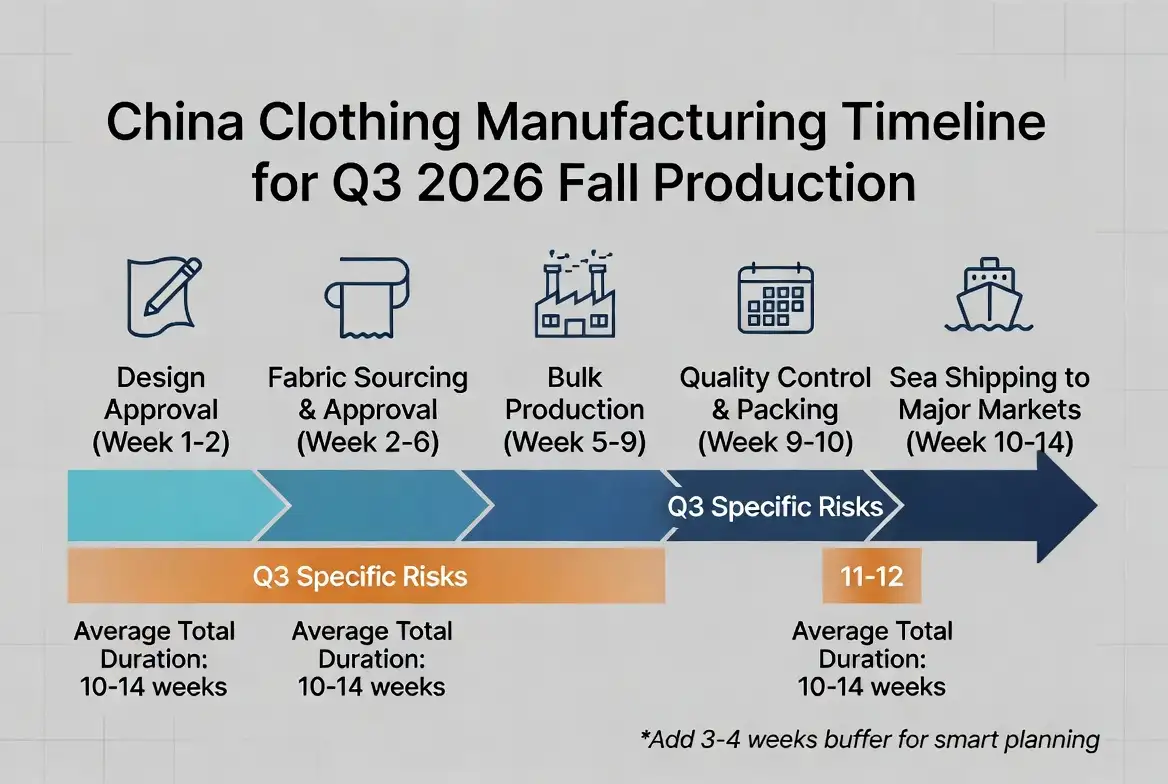
Typical clothing manufacturing timeline in China (industry benchmarks 2025–2026):
Sampling & approval: 5–15 days
Fabric sourcing & approval: 2–4+ weeks (critical bottleneck)
Bulk production: 20–35 days (depending on complexity and MOQ)
QC, packing & final inspection: 5–10 days
Sea freight + customs: 25–45+ days to major markets
End-to-end realistic range: 10–16 weeks. Smart brands add a 3–4 week buffer specifically for Q3 variables.
Q3 is when mills prioritize peak-season orders. Popular fall fabrics (heavyweight fleece 350–400 GSM, wool blends, or performance knits) often face allocation shortages or 15–30% price spikes.
Factory view: Fabric mills usually require their own MOQ (often 500–1,000 meters per color) and 4–8 week lead times. If your garment factory doesn’t have vertical integration or pre-booked greige stock, your bulk production slot becomes hostage to upstream delays.
Potential loss: 3–6 week slippage can easily trigger $50K+ in combined effects (air freight premiums + missed wholesale windows).
How smart brands avoid it: Lock fabric allocations and lab dips by late Q2. Work with factories that control fabric development or maintain key base fabric inventory. Confirm fabric readiness before confirming bulk production dates.
Many brands push fall production simultaneously in Q3. Reliable factories with good quality and communication get fully booked. Smaller or new orders get deprioritized or pushed into later slots.
Quantifiable impact: Production that should take 25–30 days can stretch to 45+ days. For a mid-size order (3,000–8,000 units), this frequently results in missed delivery dates and six-figure revenue impact.
Avoidance strategy: Secure production slots with non-refundable deposits 8–12 weeks in advance. Choose partners who offer transparent capacity calendars and dedicated lines for repeat clients. Understand their monthly output volume and current booking status before placing orders.
Q3 overlaps with peak typhoon season in Guangdong, Fujian, and Zhejiang — China’s major apparel manufacturing clusters. Storms cause factory shutdowns, power outages, worker absenteeism, and port backlogs.
Realistic impact: Local production halts of 3–10 days plus shipping congestion that adds 1–3 weeks. Combined effect on tight calendars is severe.
Avoidance: Build explicit weather buffers into your calendar. Partner with factories that have multi-site or inland capabilities. Monitor forecasts proactively and maintain relationships with forwarders who can pivot routing quickly.
Higher order volumes in Q3 overload both factory QC teams and third-party inspection services. Issues discovered late trigger rework cycles that reset timelines.
From the production floor: A single failed AQL inspection can add 7–14 days. Repeat issues compound quickly.
Financial exposure: Rework labor + re-inspection + potential air freight easily exceeds $20K–$60K on mid-volume orders.
Prevention: Insist on in-line QC processes and pre-production meetings with approved samples locked. Select factories with strong internal quality systems and real-time reporting rather than relying solely on final inspection.
Even without major global crises, Q3 can see container shortages and port congestion as volumes build toward year-end. Freight rate swings and customs delays remain common.
Data point: Sea freight from China to the US/EU normally 25–40 days but frequently extends to 45–60+ days with congestion. Air freight costs 4–6x more.
Avoidance: Book freight capacity early. Use experienced forwarders familiar with your factories. Calculate total landed cost with realistic buffers instead of optimistic schedules. Some factories offer support coordinating FOB or door-to-door options.
Ongoing US-China trade dynamics and evolving compliance requirements (forced labor documentation, sustainability disclosures, etc.) create cost and documentation uncertainty. Sudden changes can alter landed costs or delay clearance.
Practical effect: Even a 10–25% tariff swing or documentation hold-up destroys margin projections and can hold shipments at port.
Mitigation: Work with factories that maintain strong compliance records (BSCI, SEDEX, etc.) and can provide required documentation quickly. Factor current tariff realities into costing from day one and maintain flexibility in sourcing strategy where possible.
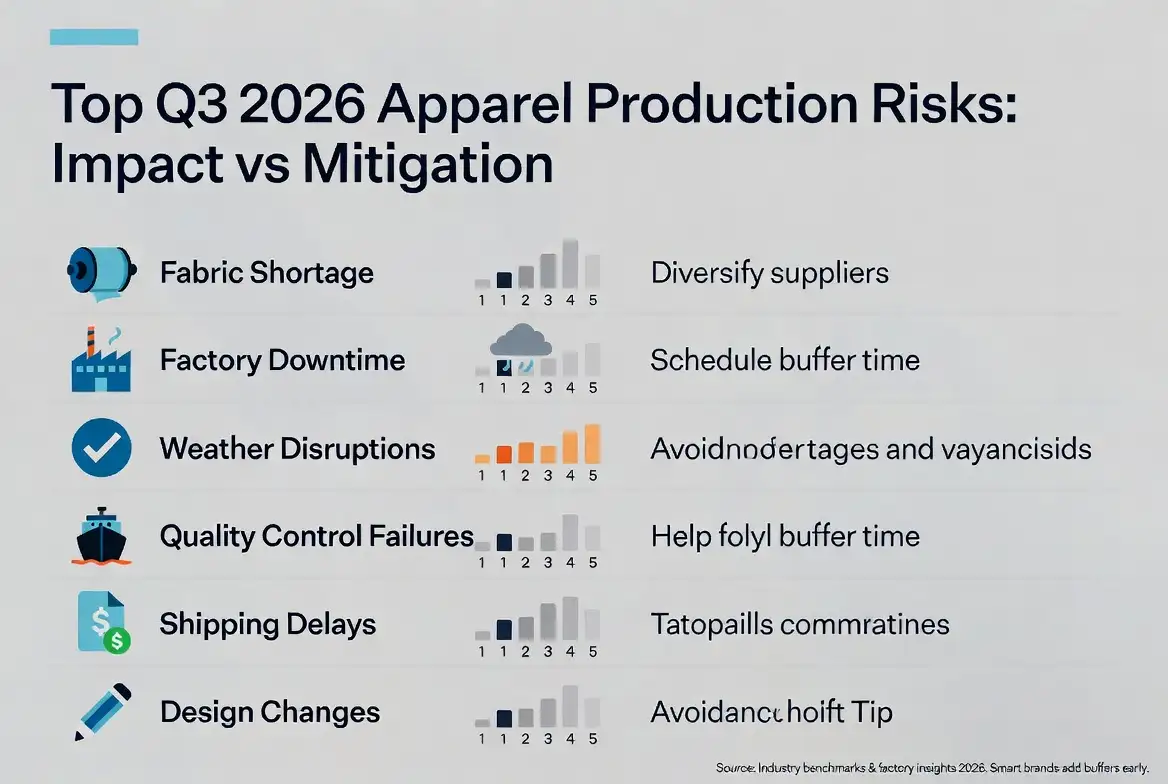
Fashion inherently involves revisions, but in Q3’s compressed window, even small changes (color, trim, fit) cascade into fabric re-orders, production rescheduling, and full timeline resets. Rush fees of 20–50% are common.
Avoidance: Enforce hard design freeze deadlines. Use digital sampling and 3D tools for faster iterations earlier in the process. Choose manufacturing partners who are agile enough for minor adjustments without derailing the entire schedule — but still disciplined about change-order protocols.
| Risk | Typical Added Delay | Potential Financial Impact | Key Avoidance Lever | Recommended Buffer |
|---|---|---|---|---|
| Fabric Sourcing | 2–6 weeks | High | Pre-book fabric + vertical partners | 4+ weeks |
| Factory Capacity | 2–4 weeks | Very High | Early slot booking | 3–4 weeks |
| Weather (Typhoon) | 1–3 weeks | Medium-High | Multi-site + weather buffers | 2–3 weeks |
| Quality Bottlenecks | 1–2 weeks | High | In-line QC + strong internal systems | 1–2 weeks |
| Shipping & Logistics | 1–4 weeks | High | Early booking + reliable forwarders | 3 weeks |
| Tariffs & Compliance | Variable | High (cost) | Compliant factories + documentation | Built into costing |
| Design Changes | 1–4 weeks | Very High | Hard freeze dates + agile partners | Plan for 1 revision |
Early-stage / startup brands: Prioritize factories offering flexible MOQ (300–500 pcs) and excellent communication. Accept slightly higher per-unit cost for timeline reliability and lower risk of total loss.
Growth-stage brands: Secure capacity with 2–3 proven partners. Invest in deeper visibility (weekly production updates, fabric status reports). Lock key fabrics early.
Mature brands: Use a core + backup strategy. Maintain long-term capacity agreements and consider modest diversification while keeping the majority with high-performing China factories that deliver predictability.
The single biggest lever remains choosing the right manufacturing partner — one that treats your calendar with the same seriousness you do.
Q: What is a realistic production timeline if I start bulk in Q3 for fall delivery?A: Plan for 10–14 weeks end-to-end from bulk production start to warehouse arrival in major markets. Add 3–4 weeks buffer for Q3-specific risks. Earlier fabric booking is essential.
Q: Can MOQ be lowered to reduce financial exposure on risky orders?A: Yes. Many factories now offer flexible MOQ (300–500 pcs per style/color) especially for established relationships or when using existing base fabrics. However, very low MOQs can sometimes extend timelines — confirm lead times explicitly.
Q: How much extra should I budget for potential delays in Q3?A: Smart brands build 15–25% contingency on logistics and allow for one round of minor changes. More importantly, they prevent delays through early action rather than paying rush premiums later.
Q: Which single action reduces the most Q3 production risk?A: Securing both fabric allocations and production slots as early as possible (ideally Q2). Everything else becomes easier when these two foundations are solid.
Q: How do I evaluate whether a factory can actually deliver on timeline promises?A: Ask for their current capacity calendar, references from similar seasonal orders, and examples of how they handled previous disruptions (weather, material shortages). Real-time visibility and proactive communication are stronger signals than optimistic quotes.
In 2026, Q3 2026 apparel production risks will separate brands that deliver on time from those absorbing painful losses. The factories that consistently perform are those with strong upstream control, transparent calendars, and the discipline to say “no” to unrealistic timelines.
The brands that win are those who stop treating manufacturing as a commodity purchase and start treating it as a core competitive capability.
Achieving reliable Q3 2026 production and protecting your margins comes down to partnering with a manufacturer that combines deep technical expertise with genuine understanding of brand timelines and commercial realities. This is precisely the value delivered by professional OEM/ODM partners like yiteclothing.com.
We help brands build realistic production calendars, secure fabric and capacity early, maintain full visibility throughout the process, and offer flexible yet disciplined MOQ and production options tailored to fall/winter programs.
Ready to de-risk your Q3 2026 production? Contact our team at yiteclothing.com to review your upcoming styles and build a customized sourcing and production timeline that protects both your schedule and your bottom line.


