Views: 0 Author: Site Editor Publish Time: 2026-04-11 Origin: Site
Procurement decision makers at cost-sensitive brands know the feeling: another quarter, another layer of uncertainty around tariff impact clothing imports. With china clothing tariff structures evolving rapidly and apparel sourcing strategy now a boardroom priority, the difference between thriving and merely surviving comes down to data-driven decisions rather than panic moves. As a China-based OEM/ODM manufacturer serving global streetwear and custom apparel clients, we witness daily how these shifts reshape orders, timelines, and margins. This guide cuts through the noise with the latest 2026 rates, practical lookup methods, landed cost formulas, and proven adaptation tactics—all from the factory floor perspective.
The tariff impact clothing landscape in 2026 stabilized after volatile 2025 adjustments, but the core structure remains layered: standard Most-Favored-Nation (MFN) rates plus Section 301 additional duties specific to China-origin goods. Post-Supreme Court rulings that struck down many IEEPA-based surcharges (including fentanyl-related and reciprocal tariffs), the effective rates for apparel (HS Chapters 61 and 62) now typically range from 20% to 45% total, depending on exact HTS code and fiber content.
Key benchmarks for common categories:
| Apparel Category | Example HTS | MFN Rate (approx.) | Section 301 Add-on | Total Effective Tariff | Notes |
|---|---|---|---|---|---|
| Knit T-shirts/Hoodies | 6109/6110 | 16.5% | 7.5%–25% | 24%–41.5% | List 4A (most common) at lower end; List 3 higher |
| Woven Shirts/Jackets | 6205/6203 | 15–20% | 7.5%–25% | 22.5%–45% | Synthetic fibers push MFN higher |
| Cotton Fleece Tracksuits | 6103/6104 | 10–16% | 7.5% | 17.5%–23.5% | Lower MFN favors natural fibers |
| Denim Jeans/Shorts | 6203/6204 | 16.5% | 7.5%–25% | 24%–41.5% | Volume-heavy categories hit hardest |
These figures exclude minor fees like Merchandise Processing Fee (0.3464%) or Harbor Maintenance (0.125% for ocean). Real-world tariff impact clothing often lands 3–5% higher when including broker and compliance costs. The good news from the supply chain side? China factories have absorbed efficiency gains, keeping FOB prices competitive enough that total landed costs frequently beat alternatives despite the add-ons.
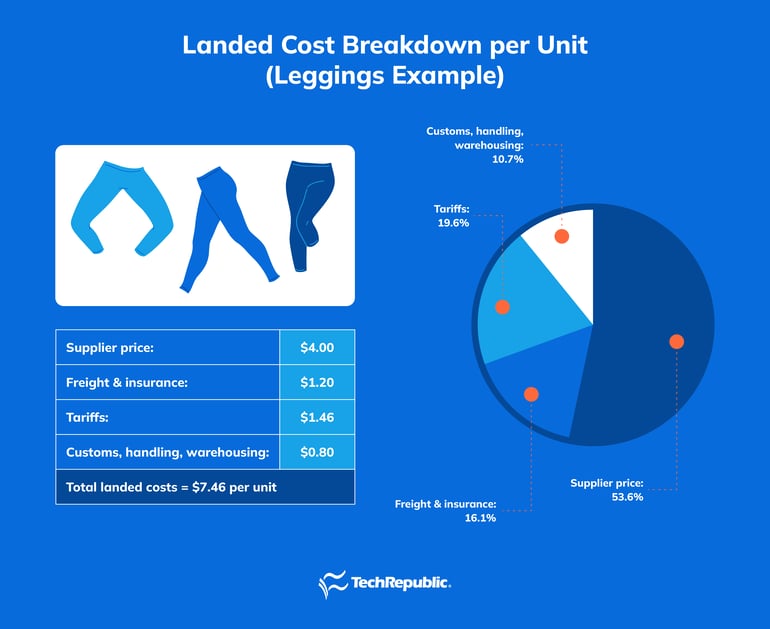
Every smart apparel sourcing strategy starts here: moving beyond FOB sticker price to true landed cost. The formula is straightforward yet powerful:
Landed Cost per Unit = (Supplier FOB Price) + (Freight per Unit) + (Duty/Tariff per Unit) + (Insurance + Broker + Other Fees per Unit)
Example for 500 custom hoodies (380 GSM fleece, China origin):
Supplier FOB: $10/unit → $5,000 total
Ocean freight (20ft container share): $1,500 → $3/unit
Duty (assume 30% effective on $5,000 value): $1,500 → $3/unit
Insurance (1% of value) + Broker ($150) + Handling: ~$0.80/unit
Total landed: $16.80/unit (68% above FOB).
Switching to air or partial container drops freight to $2/unit but raises per-unit overhead. Tools like Flexport’s Tariff Simulator or official USITC HTS search deliver real-time precision—input your exact HTS and origin for instant duty preview.
From our production lines, we’ve seen brands shave 8–12% off landed costs simply by confirming HTS early and tweaking GSM or fiber blends (cotton often qualifies for lower MFN brackets than 100% polyester).
No more guessing. Head to the U.S. International Trade Commission’s HTS search (dataweb.usitc.gov) and enter your 10-digit code—results update through March 2026. For quick estimates, Flexport’s free simulator or PineBill’s China-specific calculator factors in current Section 301 layers instantly. Pro tip: share your tech pack with your Chinese supplier upfront; we classify accurately and flag optimization opportunities before cutting fabric. This prevents the classic 15% surprise at customs.
Tariff impact clothing doesn’t have to erode margins. Here’s what works on the factory floor:
Master landed cost modeling before every PO – Build it into your ERP. Brands doing this quarterly reduce over-ordering by 20%.
Diversify intelligently, not reactively – Shift 20–30% volume to Vietnam or Bangladesh, but keep core SKUs in China for speed and low MOQ.
Engineer for tariff efficiency – Prefer cotton-heavy specs where MFN drops 4–6 points; our teams run side-by-side costing in 48 hours.
Lock low-MOQ partners for agility – Test new designs at 100–300 units without tariff exposure ballooning on dead stock.
Forward-buy strategically – Secure Q4 capacity now at pre-hike pricing; we offer 90-day price holds on existing programs.
Demand full transparency from suppliers – Insist on duty-inclusive quotes and UFLPA compliance docs upfront.
Here’s a side-by-side from real 2026 client data:
| Origin | Tariff Add-on | Avg. FOB Unit (Hoodie) | Typical MOQ | Lead Time | Landed Cost Advantage |
|---|---|---|---|---|---|
| China | 7.5–25% | $8–12 | 100 pcs | 15–25 days | Best for testing & speed |
| Vietnam | 0% | $10–15 | 500 pcs | 30–45 days | Strong for steady volume |
| Bangladesh | 0% | $7–11 | 1,000 pcs | 45–60 days | Lowest base but slow |
China often wins on total cost + flexibility for brands under $5M annual volume.
Q: Can the minimum order quantity (MOQ) be lowered to offset tariff impact clothing costs?A: Absolutely. Through fabric inventory sharing and partial production runs, we routinely deliver at 100–200 units—ideal for brands testing tariff-adjusted pricing without full-container risk.
Q: How do I get a real-time U.S.-China clothing tariff lookup for my exact style?A: Share your tech pack or HTS code with us; we cross-reference the latest Section 301 lists and return a landed cost sheet within 24 hours—no broker needed upfront.
Q: Does switching fibers really reduce china clothing tariff exposure?A: Yes—cotton blends can drop MFN by 4–8 points versus synthetics. We’ve helped three clients save 6% on landed costs this year through targeted spec tweaks.
Q: What’s the biggest hidden cost in apparel sourcing strategy under 2026 tariffs?A: Compliance and broker fees (often $150–300 per entry) plus delayed cash flow from higher duties. Transparent suppliers who pre-calculate everything cut this by 40%.
Q: Will tariffs keep rising, or is 2026 the new normal?A: Post-ruling stabilization suggests the current MFN + 7.5–25% structure holds unless new legislation emerges. Brands building resilient China partnerships now gain the biggest edge.
The bold truth from the production floor in 2026: tariffs won’t vanish, but the brands that treat apparel sourcing strategy as a collaborative science—not a price hunt—will dominate. Those who master landed cost math, optimize specs, and maintain agile low-MOQ lines turn tariff pressure into competitive advantage, delivering fresher drops at healthier margins while competitors chase cheaper (but slower) origins.