Views: 0 Author: Site Editor Publish Time: 2026-05-29 Origin: Site
Transitioning from a design concept to a scalable streetwear brand hinges entirely on supply chain execution. You might draft brilliant concepts. However, standard apparel factories often fail at streetwear. They usually lack the technical infrastructure for oversized cuts. They struggle processing heavyweight fabrics. They frequently mismanage specialized washes. A basic t-shirt factory cannot capture the premium, structural feel modern consumers demand.
This guide tackles these exact operational pain points. We provide a rigorous evaluation framework. You will learn how to vet, test, and secure a Streetwear Manufacturer. This process ensures your chosen partner aligns perfectly with your brand’s operational rhythm. It also guarantees strict adherence to your high quality standards. You will discover actionable steps to mitigate international sourcing risks and protect your initial capital.
Capability over capacity: A reliable streetwear manufacturer must prove expertise in high-GSM fabrics (260-600g), custom silhouettes (boxy, cropped), and complex dye/wash processes.
System alignment matters: A perfect sample is useless if the factory's production systems cannot guarantee sample-to-bulk consistency.
Start with a pilot run: Always test a new manufacturing partner with a 50-100 unit order to evaluate communication, lead times, and QC adherence.
Protect your capital: Never pay 100% upfront. Use secure payment gateways, require third-party inspections, and negotiate delay penalty clauses.
General clothing factories produce millions of garments annually. Yet, they rarely understand the nuances of urban fashion. You must differentiate between mass-market producers and specialized streetwear experts. They require vastly different equipment, training, and material sourcing networks.
Streetwear demands structure and durability. You must verify the factory’s ability to source, cut, and sew high-GSM cotton and fleece. These materials typically range from 260 to 600 GSM (grams per square meter). Standard sewing machines often choke on 600 GSM French terry. They drop stitches or snap needles. Assess their shrinkage testing protocols. Heavyweight garments easily warp after washing if improperly preshrunk. Always demand strict seam reinforcement standards. Twin-needle stitching on shoulders and hems prevents blowout during heavy wear.
Standard tubular blanks will not work for high-end streetwear. Boxy, oversized, or cropped fits define the culture. The factory must demonstrate absolute proficiency in drafting custom patterns. Ask for concrete examples of their custom grading rules across different sizes. An oversized medium does not scale linearly to an oversized extra-large. A skilled pattern maker adjusts drop shoulders and armhole depth proportionally. Poor grading ruins the intended drape on larger bodies.
Modern collections rely heavily on distinct fabric finishes. Evaluate their portfolio for specialized surface treatments. Look for successful examples of acid wash, enzyme wash, and garment dyeing. Controlled distressing also requires a delicate touch to avoid destroying the garment's structural integrity. Request historical data on batch-to-batch color variance. Acid washing is notoriously inconsistent. Furthermore, verify their chemical safety compliance. Certifications like OEKO-TEX prove they avoid toxic dyes.
Streetwear identity thrives on bold branding. Check their internal capabilities for streetwear staples. Puff ink printing must hold its loft after multiple washes. High-density embroidery should feel thick and rigid, not loose or puckered. Rhinestone application requires heavy-duty heat pressing to survive daily use. Finally, evaluate their custom hardware sourcing. They should easily acquire heavy-duty two-way zippers, branded aglets, and custom metal rivets.
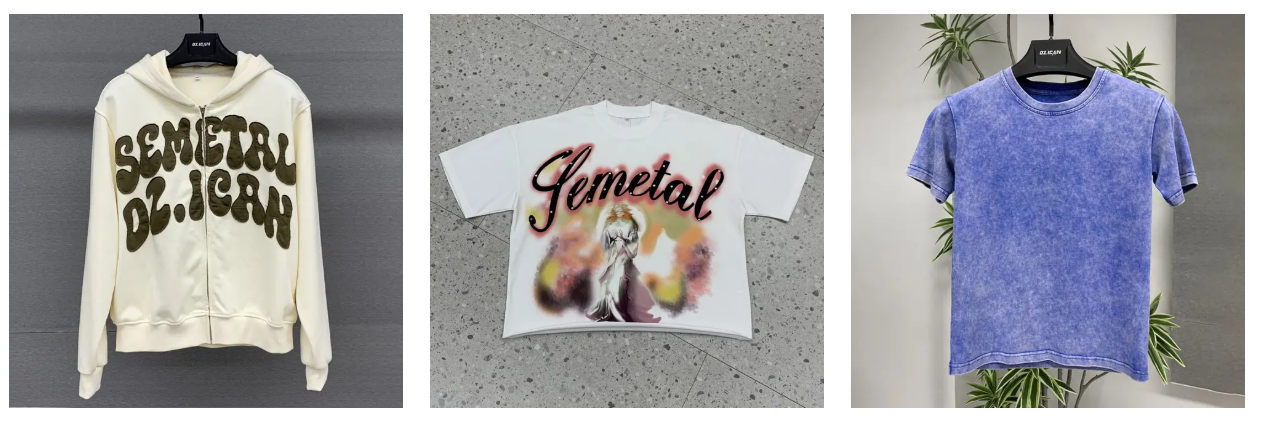
Choosing your manufacturing approach dictates your budget, timeline, and creative freedom. You must match the production model to your current technical requirements.
This model is best for graphic-heavy brands testing the market. You buy premade garments and add your art. Evaluate wholesale blank suppliers carefully. Focus on premium, eco-friendly options. Pair these blanks with top-tier local screen printers. This route offers incredible speed. You can launch a collection in weeks instead of months.
Risk factor: You have limited control over garment fit. Customization remains heavily restricted. You cannot alter the hood size, change the pocket placement, or use proprietary fabrics.
This approach is strictly necessary for brands requiring proprietary fits. If you need custom paneling and unique fabrics, you must choose cut and sew. It requires deeper vetting of the factory's raw material sourcing networks. You dictate every single stitch, label, and hem.
Risk factor: Expect much longer lead times. Operations often take 4 to 12 weeks. Factories also demand higher minimum order quantities (MOQs). This ties up significant capital early in your brand's life cycle.
| Feature | Blanks + Local Printing | Full Cut and Sew |
|---|---|---|
| Initial Cost | Low to Medium | High (Requires pattern making & sampling) |
| Speed to Market | Fast (2-4 weeks) | Slow (8-14 weeks) |
| Customization Level | Low (Only surface graphics) | Maximum (Full structural control) |
| Typical MOQs | None to Very Low (1-24 units) | High (50-300+ units per colorway) |
Your factory's operational model must match your sales strategy. Streetwear brands usually operate on a high-frequency "drop" schedule. If your supplier cannot keep pace, you will lose momentum.
Never commit to massive bulk orders immediately. Seek a capable Streetwear Manufacturer willing to start small. Look for low MOQs ranging from 50 to 100 units for initial pilot runs. Use this pilot to test more than just the physical product. Evaluate the factory’s responsiveness. Monitor their problem-solving transparency. If they hide mistakes during a 50-unit run, they will certainly hide disasters during a 500-unit run.
A flawless prototype can easily mask mass-production flaws. The sample room uses highly skilled master tailors. The main production floor relies on assembly line workers. Evaluate the factory’s internal QA systems. Ask how they transfer information from the sampling room to the main production floor. Do they create detailed construction manuals? Do they hold pre-production meetings? Poor internal communication destroys sample-to-bulk consistency.
Determine if the factory is structured for speed-to-market. Hype dictates streetwear success. Can they handle rapid reorders if a specific piece goes viral? Discuss their raw material inventory. If they keep popular heavyweight fleece in stock, they can cut turnaround times in half. Fast scalability prevents costly out-of-stock scenarios during peak demand.
Communication breakdowns ruin entire collections. When sourcing overseas, language barriers and timezone differences amplify small errors. You must standardize your communication protocols to mitigate these common points of failure.
Consider your Tech Pack a binding contract. It must be brutally exhaustive. Assume nothing. If a detail is omitted, the factory defaults to the cheapest standard method. A professional Tech Pack leaves zero room for interpretation.
You must include these critical components:
Bill of Materials (BOM): List every fabric, zipper, thread, and label required.
Precise Measurements: Provide grading charts for every size (S to XXL).
Pantone Codes: Specify exact color matches for fabrics and prints.
Stitch Types: Demand specific finishes like cover-stitching or flatlock seams.
Placement Grids: Show exact centimeter distances for logos and pockets.
Terminology varies wildly across borders. Ensure the factory truly understands streetwear-specific vocabulary. Words like "boxy cut," "drop shoulder," or "lofty" might confuse a traditional tailor. Provide reference images alongside definitions. Look for proactive communication during this phase. A reliable partner points out structural flaws in your Tech Pack before cutting any fabric. If they silently follow a flawed design, they prioritize immediate payment over long-term partnership.
Securing a great factory is only half the battle. Establishing strict commercial safeguards prevents catastrophic financial losses. You must protect yourself before finalizing any agreement.
Never wire full payments upfront. Scams and sudden factory bankruptcies happen frequently. Use secure channels like Letters of Credit (L/C) or Trade Assurance. If you use PayPal, categorize the transaction as "Services." Never use the "Friends & Family" option, as it strips away buyer protection. Implement a standard milestone payment structure. Pay 30-50% upfront to cover raw materials. You release the remaining balance only after a successful final inspection.
Factory delays represent a chronic industry issue. Protect your brand by writing penalty clauses directly into the purchase order. For example, stipulate a 10-15% discount if delivery is late by more than 14 days. These clauses force factories to prioritize your production run over uncontracted clients. It keeps them honest about their actual capacity limits.
Never trust factory-provided photos of your finished bulk order. Hire independent QC inspectors. Have them visit the factory during production. This is called an Inline Inspection. It catches errors before the entire batch is sewn. Follow up with a Final Random Inspection before shipping. Additionally, check historical audit reports. Verify the factory's physical address accurately matches their legal documentation to avoid middleman trading companies.
Relying on a single factory invites disaster. Geopolitical disruptions, sudden capacity limits, or environmental issues can halt production overnight. Maintain active relationships with three to five backup manufacturers. Send them occasional sample requests. Keep them updated on your brand's growth. This roster prevents prolonged stockouts if your primary supplier suddenly fails.
Choosing the right production partner remains an ongoing process of strict risk management and careful relationship building. The lowest price usually hides the highest long-term risk. Prioritize factories demonstrating deep technical expertise and transparent communication systems. They must handle heavyweight materials and complex silhouettes effortlessly.
Your immediate next steps are clear:
Finalize a watertight Tech Pack detailing every stitch and measurement.
Shortlist 3 to 5 vetted factories specializing in urban fashion.
Begin requesting precise quotes and test samples.
Structure your initial payment terms to protect your capital.
Launch a 50-100 unit pilot run to test real-world scalability.
A: A realistic MOQ for starting out sits between 50 and 100 units per colorway. This sweet spot allows you to test the factory's capabilities without risking massive capital. While larger factories demand 500+ units for scale economies, specialized urban producers understand the necessity of small-batch pilot runs.
A: The process generally takes 6 to 12 weeks. Expect 2 to 4 weeks for initial pattern making and sampling. Once you approve the sample, bulk production takes another 4 to 8 weeks. Remember to factor in international freight time, which adds 1 to 4 weeks depending on shipping methods.
A: The US and EU offer excellent fast-turnaround blanks and local printing. For advanced cut and sew, Guangzhou and Dongguan in China are global hubs for heavyweight fabrics and complex washes. Pakistan is also emerging as a highly competitive region offering excellent pricing for custom fleece and low-MOQ runs.
A: You should require the factory to sign NNN agreements (Non-Disclosure, Non-Use, Non-Circumvention) before sharing Tech Packs. However, keep expectations realistic regarding legal enforcement overseas. Building a strong, mutually profitable relationship often serves as the most practical defense against intellectual property theft.


