Views: 0 Author: Site Editor Publish Time: 2026-10-18 Origin: Site
The massive resurgence of the flared silhouette in streetwear and athleisure has completely redefined modern loungewear. These bottoms offer a perfect blend of relaxed comfort and retro-inspired aesthetics. They have quickly become a non-negotiable staple in everyday wardrobes. Consumers and designers alike frequently run into a frustrating structural pain point. Garments lose their architectural integrity. After just a few hours of running errands or lounging, the material develops unsightly sagging at the joints. The crisp bell-bottom hem can easily collapse into a sloppy puddle of cloth.
Solving this issue requires looking closely at the raw materials used in manufacturing. This brings us to the two heavyweight contenders in the knitwear industry. We must compare French Terry and Fleece objectively to determine which material provides superior structural memory. Whether you are upgrading your personal closet or looking to manufacture high-quality custom flared sweatpants for an emerging clothing brand, understanding the mechanical properties of these knits is crucial for making an informed decision.
Recent textile supply chain analyses highlight a noticeable shift in consumer preferences within the athleisure market. Everyday wear increasingly demands aesthetic sharpness alongside functional longevity. Market data indicates a growing inclination toward mid-weight high-recovery knits over traditional heavy brushed materials for structured bottoms. This trend underscores a broader movement where shoppers prioritize garments that maintain their architectural integrity from morning commutes to evening lounging. Static warmth is no longer the sole purchasing driver for premium loungewear.
To accurately predict how a garment will behave over a long day of wear, we must examine how its textile is knitted and finished at the mill. Both materials often start from the exact same base yarns. Their distinct finishing processes give them entirely different physical behaviors.
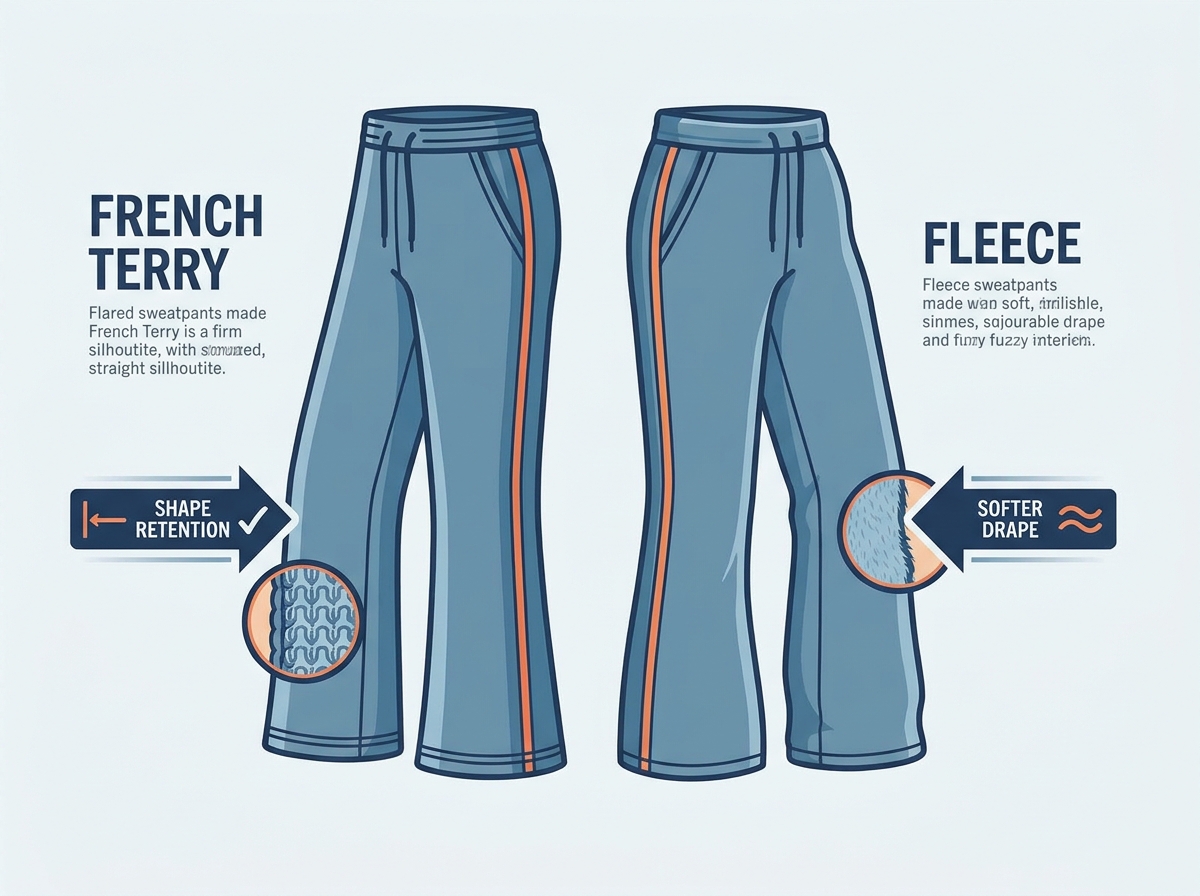
French Terry fabric is a versatile knit textile characterized by its distinct two-sided construction. The exterior surface presents a smooth flat face. The interior features a dense network of soft unbrushed yarn loops. Because these loops remain intact and uncut, the material maintains a moderate weight that typically ranges from 280 to 360 grams per square meter. This looped internal structure creates microscopic air pockets. It allows for natural moisture-wicking properties, actively pulling sweat away from the skin. Furthermore, the unbroken loops provide a built-in mechanical elasticity. This allows the garment to stretch and recover its original dimensions efficiently.
In the context of casual loungewear, this material typically begins its life on the knitting machines in a manner nearly identical to its looped counterpart. During the finishing stage, the textile undergoes a specialized process called napping or brushing. Fine wire brushes are run aggressively over the interior. They intentionally break the yarn fibers and tease them out to create a fuzzy plush pile. This brushed interior traps dead air exceptionally well. It delivers signature insulation and a cloud-like hand-feel. In contrast, physically shredding the loops alters the structural memory of the textile. This alteration has direct implications for how the material drapes, stretches, and recovers over time.
The flared cut is a uniquely demanding garment. It requires two seemingly contradictory physical properties from its fabric. It must fit snugly in specific areas while cascading elegantly in others.
By design, flared sweatpants fit tightly through the thigh and taper at the knee before dramatically widening toward the hem. This specific tailoring concentrates high levels of mechanical stress directly on the patella. Imagine sitting at a coffee shop for an hour. You stand up only to find the fabric pooling awkwardly around your kneecaps. Every time you sit, squat, or walk, the knee acts as a hinge. It stretches the fabric to its limits. If the textile lacks sufficient elastic recovery, the yarns undergo plastic deformation. This results in the permanent unsightly sagging commonly referred to as baggy knees.
Below the knee, the visual success of the garment relies entirely on its drape. The fabric must possess the correct weight and fluidity to fall elegantly over chunky sneakers or platform boots. If the material is too stiff and heavy, the flare will look rigid and unnatural. It resembles a stiff bell rather than a smooth cascade. Conversely, if the material is too flimsy, the hem will flop uncontrollably and fail to maintain a defined silhouette. Striking this delicate balance is why fabric selection is paramount.
To provide a clear engineering perspective, we evaluated both fabrics across five critical metrics essential for tailored loungewear.
| Performance Metric | French Terry | Fleece |
|---|---|---|
| Shape Retention | Excellent. Intact loops act as springs for high tensile recovery. | Moderate to Low. Broken fibers lead to plastic deformation at joints. |
| Drape & Fluidity | High. Mid-weight structure allows the flare to cascade smoothly. | Low. Thicker pile creates a stiffer, bell-like silhouette. |
| Thermal Insulation | Moderate. Breathable and suited for multi-season wear. | Maximum. Traps dead air efficiently for freezing temperatures. |
| Breathability | High. Micro-air pockets wick moisture away from the skin. | Low. Dense brushed interior retains heat and moisture. |
| Pilling Resistance | High. Smooth interior and exterior resist friction wear. | Low. Fuzzy brushed interior is highly susceptible to thigh friction. |
When directly comparing these two fabrics for form stability, textile mechanics provide a definitive answer. The way each material responds to tension, movement, and gravity dictates its performance in a tailored silhouette.
Because the interior loops remain intact, the yarns retain their original tensile strength. This unbroken structure acts like a series of microscopic springs. When the fabric is stretched tightly over the knee joint, the loops elongate. The moment tension is released, they naturally contract back to their resting state. Consequently, French Terry resists bagging out far more effectively than its brushed counterparts. Specifically, its slightly denser flat profile carries just enough weight to pull the flare down cleanly over footwear. This ensures a sharp consistent geometry throughout the day.
Fleece fabric prioritizes thermal insulation over structural memory. The brushing process that creates its signature soft interior inherently weakens the yarn matrix. By breaking the loops to create a fuzzy pile, the fabric sacrifices a significant portion of its natural mechanical elasticity. When subjected to repeated stress at the knee, these weakened fibers are highly susceptible to stretching out and failing to recover. A heavyweight fleece exceeding 400 grams per square meter can hold a very stiff exaggerated flare due to its sheer thickness. However, it often feels overly bulky and lacks the elegant flowing drape required for modern fashion aesthetics.
Beyond construction techniques, the raw material composition plays an equally critical role in how a garment holds its shape over time. A fabric is only as strong as the fibers woven into it.
Garments crafted from pure cotton are highly breathable, hypoallergenic, and exceptionally comfortable. Natural cotton fibers possess relatively poor elastic recovery. Whether knitted as French Terry or Fleece, pure cotton will inevitably stretch out over time. Blending cotton with synthetic fibers like polyester fundamentally alters the fabric performance. Polyester adds durability, abrasion resistance, and crucial structural memory. An industry-standard blend, such as 80 percent Cotton and 20 percent Polyester woven at 320 grams per square meter, offers a pragmatic compromise. It provides the soft hand-feel of cotton alongside the stabilizing strength of synthetics.
For flared silhouettes that demand a tight fit through the thigh and knee, the inclusion of an elastomeric fiber is non-negotiable. Introducing just 2 to 5 percent Spandex into the fabric matrix completely transforms its recovery rate. Spandex fibers can stretch up to five times their original length. They snap back precisely to their starting dimensions. When evaluating fabrics for form stability, any blend containing a touch of spandex will drastically outperform standard knits. This engineering trick effectively banishes baggy knees forever.
For brands, designers, and business buyers looking to launch an apparel line, selecting the correct fabric is the foundational step in product development. Your choice directly dictates the perceived quality, durability, and ultimate customer satisfaction.
If your demographic caters to a streetwear audience looking for heavy, structured, oversized winter fits, a high-density poly-cotton fleece is likely appropriate. Target a weight between 350 and 400 grams per square meter. This provides maximum volume and exceptional warmth for cold climates. Be prepared to sacrifice some drape for a stiffer architectural flare.
If your audience consists of gym-goers, dancers, or consumers seeking a sleek flattering everyday athleisure piece, a mid-weight French Terry blended with Spandex is highly recommended. Utilizing a 320 grams per square meter fabric composed of 95 percent Cotton and 5 percent Spandex ensures the product looks as pristine at the end of the day as it did when first put on.
Fabric choice also dictates the success of your surface embellishments. French Terry provides a relatively stable smooth surface on both sides. It accepts screen printing, puff print, and high-density embroidery exceptionally well without puckering. Fleece presents unique manufacturing challenges. The thick plush nature of the brushed interior can cause the fabric to shift during the embroidery process. This requires heavier backing stabilizers. Designers must communicate closely with their manufacturing partners to adjust production techniques based on the chosen textile.
Even the highest quality textiles will degrade and lose their shape if subjected to improper laundering techniques. Educating yourself on garment care is essential for extending the lifecycle of the product and protecting its tailored silhouette.
Mechanical agitation and harsh chemicals break down textile fibers. Sweatpants should always be turned inside out before washing. This protects the outer face from abrasion and cleans the interior loops or pile directly. Utilizing a gentle machine cycle with cold water is highly recommended. Cold water prevents natural fibers like cotton from shrinking. It also protects synthetic blends from thermal shock.
The most critical factor in maintaining shape retention happens in the laundry room. High heat is highly destructive to Spandex and Elastane. Exposing sweatpants to the scorching temperatures of a tumble dryer causes the elastomeric fibers to become brittle. They snap and permanently lose their recovery properties. Once the Spandex is thermally degraded, the garment will suffer from irreversible baggy knees. Air drying by laying the garment flat is the optimal method. If a tumble dryer is absolutely necessary, it must be set to the lowest possible heat setting or an air fluff cycle.
In the great debate of loungewear textiles, French Terry emerges as the definitive victor for shape retention, elegant drape, and year-round wearability. Its unbroken loop structure acts as a natural stabilizer. This ensures your flared silhouette remains crisp and flattering from morning to night. Fleece provides unparalleled ultimate winter warmth and coziness. It simply cannot compete when it comes to structural memory.
When shopping or designing, always check the fabric composition tags. Opting for a blend that includes a small percentage of spandex is the ultimate secret weapon against sagging joints. Ready to bring your vision to life with premium materials? We highly recommend exploring the extensive catalog at Yite Clothing to find the perfect fabric and fit for your custom apparel line. With precise engineering and top-tier sourcing, your flared bottoms will remain a stylish perfectly fitted staple in your wardrobe for years to come.
French Terry can shrink if it is constructed from pure cotton and subjected to hot water or high-heat drying. High-quality garments made from pre-shrunk cotton or cotton-polyester blends hold their size and shape perfectly when washed in cold water and air-dried.
Yes. The brushed interior of fleece creates a lofty pile that traps body heat incredibly well. This makes it significantly warmer than French Terry. You may sacrifice a small amount of shape retention, but it remains the superior choice for combating freezing temperatures.
The most effective strategy is to purchase sweatpants made from a fabric blend containing 2 to 5 percent spandex. Prioritizing French Terry over standard fleece and strictly avoiding high-heat tumble drying will preserve the natural elasticity of the fabric and prevent knee deformation.
Absolutely. Most reputable high-quality apparel manufacturers offer both fabric options to accommodate different seasonal collections. Designers can fully customize the fabric weight, the cotton-to-polyester ratio, the inclusion of spandex, and the specific tailoring based on unique brand requirements.
If you are aiming for a highly exaggerated, voluminous, and stiff baggy look, heavyweight fleece is the better choice. Its thick brushed structure holds a wider shape away from the body. If you want a baggy fit that still drapes fluidly and moves with your body, a mid-weight French Terry is superior.
No. Compared to fleece, French Terry is highly resistant to pilling. Because the interior loops remain intact and are not brushed or shredded during the manufacturing process, there are fewer loose fibers available to tangle and form fuzzballs caused by daily friction.