Views: 0 Author: Site Editor Publish Time: 2026-09-30 Origin: Site
Designing a flawless flared silhouette demands serious structural engineering. Unlike standard cuffed joggers, these specific garments require absolute mathematical precision in their pattern making. One minor miscalculation during production can ruin the drape entirely. Choosing the wrong manufacturing partner often leads to collapsed silhouettes, warped fabrics, and inconsistent grading across your size run. You might even face unwearable shrinkage at the hem after just a single wash. These common production mistakes waste your valuable time and quickly burn through your operating budget.
This article provides a transparent, criteria-based framework designed to help you evaluate potential production partners. We will focus strictly on material sourcing, complex pattern execution, and realistic unit economics. You will learn exactly how to assess a flared sweatpants manufacturer to ensure high-quality, scalable production. From analyzing structural fabric weights to successfully negotiating minimum order volumes, you will gain the industry insight needed to build a premium, long-lasting product.
Sourcing model dictates flexibility: Your choice between private label and OEM dictates whether you control the exact dimensions of the flare.
Fabric weight is structural: Heavyweight French terry (350gsm+) is generally required to maintain the wide-leg drape and prevent the flare from clinging.
Grading the flare is complex: Competent manufacturers must demonstrate how they grade the "knee break" and inseam across different sizes without distorting the silhouette.
MOQ transparency matters: Minimum Order Quantities should be evaluated alongside sampling costs and inventory risk, not just per-unit price.
Before contacting any factory, you must define your underlying sourcing model. Two distinct pathways exist for bringing your apparel designs to life. The route you choose permanently dictates your level of creative control over the final garment fit.
Buying pre-designed, unbranded blanks defines the white labeling method. You purchase existing silhouettes and simply add custom tags, screen prints, or embroidery. The pros of this approach include significantly lower minimum orders and a much faster time-to-market. It also provides highly predictable baseline costs since the development phase is already complete.
However, the risks remain substantial for complex silhouettes. You are permanently locked into the supplier’s existing flare dimensions. If their internal block pattern fails to match your brand's unique aesthetic, you cannot alter the physical cut. You must accept the hem width and knee placement exactly as they are currently sewn. Sourcing private label sweatpants works best for early-stage brands prioritizing speed over highly bespoke tailoring.
This advanced method involves building custom flared sweatpants entirely from scratch. You provide your factory with highly detailed Tech Packs outlining every measurement. The primary advantage here is absolute creative control. You personally dictate the waist-to-hip ratio, the precise knee-break placement, and the exact circumference of the final leg opening.
Working closely with established OEM streetwear pants producers guarantees a unique, market-differentiated silhouette. The associated risks involve higher upfront financial costs for professional pattern making. You will also face considerably longer lead times for sampling and endure stricter volume requirements per style.
Production Model Comparison: Private Label vs. OEM
| Feature | Private Label (White Label) | OEM (Custom Cut-and-Sew) |
|---|---|---|
| Pattern Control | Zero control; locked into supplier's block. | 100% control over every dimension. |
| Time to Market | Fast (typically 2-4 weeks). | Slow (typically 8-12 weeks). |
| Initial MOQs | Very low (often 20-50 units). | Moderate to high (100-300+ units). |
| Best Suited For | Merch drops, budget-conscious startups. | Premium brands requiring unique fits. |
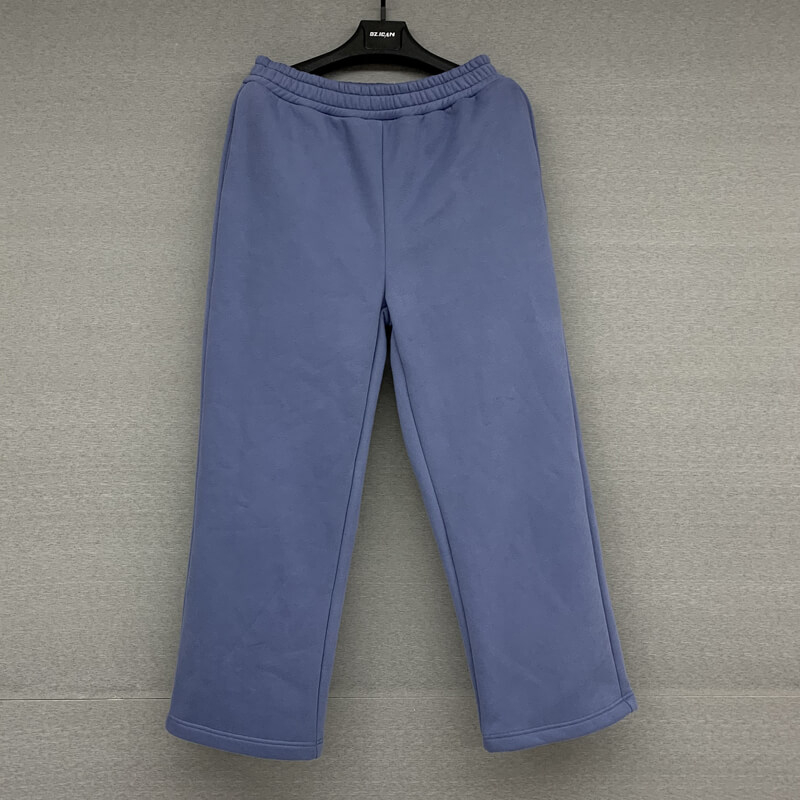
The success of a flared silhouette depends heavily on your chosen textile. Fabric behaves differently depending on its density, composition, and finishing processes. Vetting a supplier's fabric library is a mandatory step in product development.
Standard lightweight fleece fabrics under 300gsm consistently fail for wide-leg or flared cuts. These lighter materials lack the necessary internal structure to hold a shape. The resulting garment looks flimsy, clings awkwardly to the wearer's calves, and often curls up at the bottom hem after washing.
To achieve the structured, highly desired streetwear aesthetic, you need substantial physical weight. Creating authentic heavyweight French terry sweatpants generally requires materials weighing between 350gsm and 450gsm. This specific density ensures the fabric drops straight down from the knee break. It holds the bell shape open naturally, providing a premium, architectural look to the garment.
Flared pants face a unique, highly visible risk regarding fabric shrinkage. Vertical shrinkage completely ruins the carefully engineered, floor-grazing aesthetic. A two-inch loss in total inseam length transforms a stylish flare into unwearable high-water pants.
When vetting a potential factory partner, ask probing questions about their pre-shrinking processes. Inquire specifically about industrial garment washing techniques applied before the final cut. A standard acceptable shrinkage tolerance for heavy cotton is typically 3-5%. Anything higher than this margin spells disaster for your size charts. Always conduct your own home-wash testing on the initial samples to verify their shrinkage claims.
Thick, heavy fabric requires equally robust hardware to function properly. You must verify your supplier's access to high-quality drawstrings and sturdy metal aglets. Plastic aglets often crack under the pressure of industrial washing machines.
Furthermore, they must source heavy-duty, wide elastic waistbands. Thin or cheap elastic simply cannot support the physical weight of 400gsm French terry pulling down on it. The waistband will inevitably fold over, twist inside the casing, or sag uncomfortably on the wearer. Specify a minimum waistband width of two inches in your technical documentation.
Proper fit grading distinctly separates amateur sewing rooms from professional manufacturing partners. Flared bottoms require complex geometric adjustments across different sizes. You cannot simply add an inch to the perimeter and expect the proportions to hold.
The most critical dimension in any flared pant is the exact point where the widening begins. Industry professionals call this the "knee break." When vetting a new factory, always ask a highly specific technical question. Ask them how they adjust the knee placement for a size Small compared to a size Extra Large.
If they use a static measurement from the crotch down across all sizes, the flare will hit halfway down the calf on your taller customers. The knee break must scale proportionately alongside the inseam length. A competent pattern maker mathematically shifts this break point to accommodate varying heights.
You must carefully evaluate how the supplier grades the bottom hem. Expanding a waist measurement shouldn't automatically result in a drastically wider bell-bottom. A size XXL wearer needs a larger waist and hip circumference for comfort. However, unless explicitly specified in your Tech Pack, the leg opening should only widen marginally.
Poor grading creates comical, highly exaggerated bells on larger sizes. The factory must demonstrate an understanding of non-linear grading rules. Ask them to provide a sample grade rule table before you pay for any bulk production.
Consider the sheer physical weight of 400gsm fabric combined with the constant friction at the hem. These pants frequently brush against concrete floors and shoes. You must actively specify the need for reinforced stitching methods.
Robust flatlock seams or dense 5-thread overlock stitching are strictly mandatory for this style. Standard single-needle topstitching will quickly unravel at the hem due to abrasion. Protect your product's long-term reputation by insisting on industrial-grade seam finishing throughout the entire garment.
Minimum Order Quantities consistently frustrate emerging clothing brands. Understanding the manufacturing logic behind these restrictive numbers helps you negotiate much better terms.
Custom fabric dyeing inherently drives up your minimum order requirements. If your brand demands a specific, proprietary Pantone color, factories must dye the raw greige fabric from scratch. Commercial fabric mills require strict minimum yardage to operate their large dyeing vats efficiently. They physically cannot dye just ten yards of heavy French terry.
This operational constraint passes directly from the mill to the cut-and-sew factory, and ultimately down to you. If you choose stock colors like standard black, heather grey, or navy, factories can often significantly lower their MOQ demands.
Typical volume requirements vary heavily based on geographic location. Ordering 100 to 300 units per color and style is standard for most overseas wholesale flared sweatpants runs. Conversely, domestic partners may offer lower entry tiers. They might accept 50 to 100 units, but they will charge a massive premium per unit to cover their setup time.
Use a specific negotiation tactic during your initial calls. Ask if the wide leg sweatpants supplier allows "cross-sizing." This strategy involves ordering a total of 200 units, but splitting them unevenly across sizes XS through XXL. Cross-sizing helps you smartly mitigate inventory risk across your less popular extreme sizes while still hitting the factory's total volume threshold.
Never evaluate a factory's per-unit price in a vacuum. Heavyweight sweatpants weigh considerably more than standard summer t-shirts. A single pair of 400gsm French terry pants can easily weigh over 1.5 pounds.
Always remind yourself to factor in these extreme shipping weights. Shipping dense inventory by air freight costs a small fortune. Your actual final landed cost (manufacturing plus shipping plus duties) might be 30% to 40% higher than the originally quoted factory price. Always build your retail pricing models based strictly on final landed costs.
You need a highly systematic approach to narrow down your factory options. Follow these three distinct testing phases to guarantee reliable, stress-free bulk production.
Send a comprehensive, highly detailed tech pack to your top candidates. Include extensive Points of Measure (POMs) covering the outseam, front rise, back rise, thigh width, knee break, and leg opening. A trustworthy factory will reply promptly with insightful, clarifying questions. They will ask about acceptable sewing tolerances, specific needle sizes, or fabric shrinkage rates.
If a factory simply replies with a blind "yes" to everything, treat it as a massive red flag. Professional makers always review the engineering details rigorously before committing to a project.
Always require a formal Pre-Production Sample (PPS). Never move straight from a digital drawing to bulk manufacturing under any circumstances. Once you finally receive the physical sample, evaluate it ruthlessly against these criteria:
Examine the natural drape from the knee down while wearing the garment.
Measure the exact physical accuracy of the flare circumference against your original tech pack.
Assess the fabric hand-feel for appropriate softness, density, and stretch recovery.
Conduct a rigorous hot-wash and high-heat dry test to verify post-wash dimensional retention.
Look actively for hard evidence of ethical manufacturing practices. Global certifications like WRAP, SA8000, or BSCI demonstrate responsible, legal operations regarding labor and environmental standards.
Furthermore, carefully assess their communication latency and clarity. You will eventually need to troubleshoot complex fit issues across different time zones. If a factory takes four business days to answer a simple email during the honeymoon vetting stage, troubleshooting a production error later will become a nightmare. Demand clear, bilingual communication and regular photo updates.
Finding the correct manufacturing partner ultimately dictates the long-term success of your apparel brand. The ideal factory perfectly balances deep structural fabric knowledge with precise, mathematical grading capabilities. They also offer highly transparent MOQ terms and clear communication from day one. Do not ever compromise on fabric density, knee break proportions, or industrial seam construction. The highly desired drape of the flare relies entirely on these crucial structural decisions.
Your immediate next steps are highly actionable. Finalize your Tech Pack with exact measurements for your unique silhouette. Next, initiate detailed conversations with three to five shortlisted factories. Compare their sampling timelines, evaluate the quality of their technical questions, and observe their daily communication styles. Taking these methodical steps ensures your final product looks highly intentional, feels premium, and scales effortlessly.
A: The optimal fabric is 100% cotton heavyweight French terry or a dense, high-GSM fleece blend. You generally require a material weight between 350gsm and 450gsm. This substantial density provides the necessary structural integrity. It ensures the fabric drapes cleanly from the knee down without clinging awkwardly to the leg or looking flimsy.
A: Sampling typically costs between $100 and $300 per style, depending heavily on fabric sourcing and pattern complexity. For bulk manufacturing, expect per-unit costs to range from $15 to $35. Custom tailoring and proprietary dye jobs naturally cost more than standard off-the-shelf blanks. Always account for high shipping costs.
A: Generally, no. True private label blanks utilize pre-existing block patterns developed by the factory. You can easily add custom logos, unique tags, or embroidery, but you cannot alter the physical cut. To change specific measurements for the knee break or leg opening, you must pursue OEM cut-and-sew manufacturing.
A: High MOQs stem directly from raw material constraints at the mill level. Custom dyeing thick fabrics requires large vat runs. Mills enforce strict minimum yardage requirements for bespoke Pantone colors. Cut-and-sew manufacturers must pass these volume requirements onto you to cover the minimum raw materials needed.


