Views: 0 Author: Site Editor Publish Time: 2026-10-16 Origin: Site
Is your favorite fleece pullover incredibly comfortable but surprisingly unflattering? You are certainly not alone. A great piece of loungewear is arguably the ultimate wardrobe staple. Yet, finding the perfect drape often feels like a frustrating guessing game. A poor cut easily ruins your natural body shape. It makes you look sloppy, disproportionate, or completely swallowed by excess fabric.
The secret to looking stylish while maintaining that cozy feel lies in structural geometry. It requires understanding how length, width, and overall proportions interact with your specific physical silhouette. Whether you gravitate toward classic silhouettes, trendy streetwear cuts, or are exploring personalized options, this guide will help you pinpoint the exact dimensions needed to flatter your physique.
Recent apparel industry analyses reveal a massive shift in consumer expectations regarding outerwear proportions. We are moving rapidly away from the era of flimsy gym wear. Modern buyers now treat fleece tops as foundational architectural pieces for layered outfits. Market data shows a surging demand for heavyweight fabrics exceeding 400 GSM. Consumers want garments that hold their own shape rather than collapsing against the body. This evolution drives designers to abandon generic one-size-fits-all grading. Instead, the focus is on highly specialized cuts tailored to specific skeletal frames.
Understanding how a garment is constructed is the foundational step to finding outerwear that actually complements your frame. A proper drape is determined by how three primary structural anchor points interact with your body. These points are the shoulders, the torso, and the sleeves.
The placement of the shoulder seam dictates the entire structural flow of the garment. For a standard tailored appearance, the shoulder seam should sit exactly at the edge of your acromion bone, which is the bony tip of your outer shoulder. If the seam rides up toward your neck, the garment is too small and will severely restrict your daily movement. In contrast, a drop-shoulder style intentionally pushes this seam down the upper arm. While dropping the shoulder is a staple of modern relaxed fits, the seam must still lay flat against the arm without creating a sharp, protruding peak of stiff fabric.
The golden rule of garment length applies heavily to outerwear. A classic silhouette should end right around the mid-fly of your trousers, or just slightly below the belt line. Imagine reaching for a top shelf. If your hem exposes your stomach or belt during this motion, the torso pattern is objectively too short. Conversely, if it fully covers your zipper, you risk visually shortening your legs.
Regarding width, the torso must provide enough ease, meaning extra fabric space, to allow for comfortable layering over a thermal or t-shirt. However, it should not feature excessive billowing around the waist. The ribbed hem at the bottom should lightly hug the hips. This maintains the garment's structure without tightly riding up your stomach as you walk.
Sleeve length is a highly critical indicator of precision sizing. The sleeves should flow smoothly down the arm and terminate exactly at the base of the thumb or the break of the wrist. Ribbed cuffs play a highly functional role here. They should be snug enough to prevent the sleeve from sliding over your knuckles, yet loose enough that they do not leave red indentation marks on your skin. If the fabric pools heavily and creates deep folds above the cuff, the sleeves are simply too long.
Selecting the right style is now just as important as selecting the right size. Different cuts serve entirely different functional and aesthetic purposes.
The standard pullover remains a timeless wardrobe staple due to its unified front and structural simplicity. Classic pullover hoodies are characterized by a straight-cut torso, a front kangaroo pocket, and a lack of hardware. Standard versions typically utilize a 320 to 350 GSM fabric weight. This style is highly effective for everyday wear and serves as an excellent mid-layer underneath denim jackets, bomber jackets, or heavy overcoats. Because it lacks a rigid zipper, a pullover naturally maintains a flatter, smoother profile against the chest.
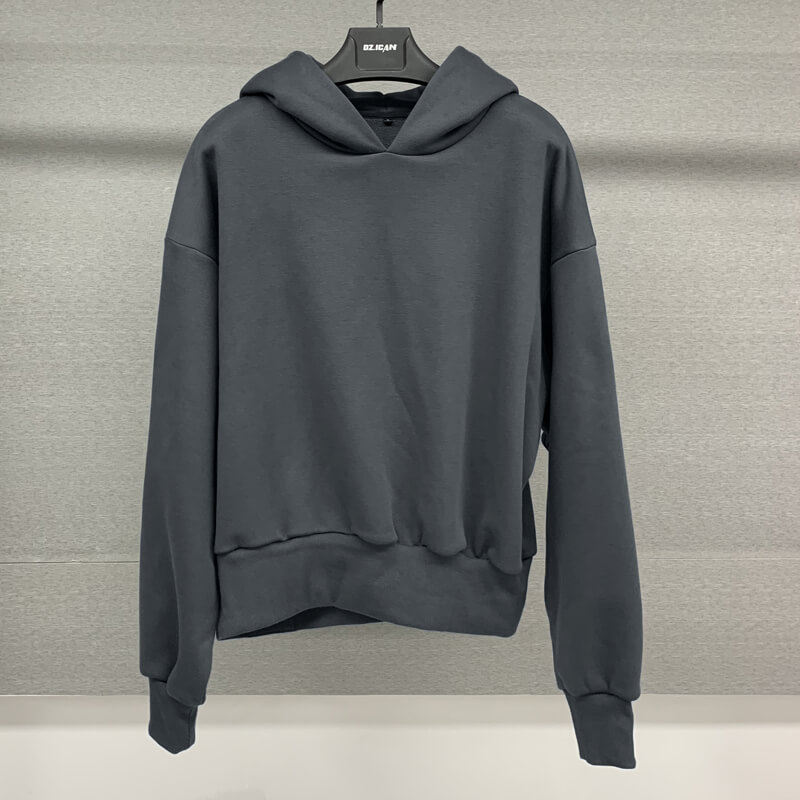
The oversized aesthetic is deeply rooted in contemporary streetwear, but achieving this look requires mathematical precision. A true oversized fit is not achieved by simply buying a standard piece two sizes larger. Purpose-built oversized garments are designed with specific geometry. For example, a plain boxy streetwear black drop-shoulder heavyweight oversized hoodie features severely dropped shoulders, a significantly wider chest circumference, and ballooned sleeves. It utilizes a dense 400+ GSM fabric to hold its boxy shape. This specific style adds profound visual weight to the upper body while keeping the hem length relatively standard to prevent the piece from looking like a nightgown.
Cropped styles fundamentally alter body proportions by artificially raising the visible waistline. By terminating at or above the natural waist, these garments draw the eye upward. This visually elongates the lower half of the body. This structural trick is incredibly effective when paired with high-waisted jeans or leggings. It provides the warmth of thick fleece while completely eliminating bulky fabric around the hips.
For those who prioritize climate control and rapid layering flexibility, the zip-up style is unmatched. A versatile zip-up hoodie generally features a slightly more fitted cut than its pullover counterpart. The vertical line created by the metal or plastic zipper visually splits the torso, which naturally produces a slimming effect. Wearing it unzipped allows the fabric to drape open casually, reducing bulk around the midsection and displaying the textured layers underneath.
To transition from generic advice to practical application, you must evaluate your specific skeletal frame. Here is exactly what to look for based on your body type.
For individuals with athletic builds, typically characterized by broad shoulders, a wide chest, and a narrower waist, the primary styling goal is to highlight the natural V-taper. The fabric should never look stretched or burst at the seams.
Slim and lean body types benefit most from garments that add structural dimension and slight volume. This prevents the wearer from looking completely swallowed by thin, clinging fabric.
For big, tall, and plus-size individuals, the objective is to create a streamlined, comfortable silhouette that elongates the body without clinging tightly to the midsection or riding up the lower back.
When dressing a shorter or petite frame, the primary styling goal is to elongate the legs and avoid a top-heavy or stumpy appearance. Proportion is everything in this scenario.
| Fit Style | Ideal Body Type | Recommended Fabric Weight | Key Structural Feature |
|---|---|---|---|
| Classic Pullover | Athletic / Average | 320 - 350 GSM | Straight-cut torso, tailored shoulders |
| Oversized / Boxy | Slim / Tall | 400+ GSM | Dropped shoulders, balloon sleeves, wide chest |
| Cropped | Petite / Short | 280 - 320 GSM | Hemline terminates at natural waist |
| Zip-Up | Broad / Plus-Size | 300 - 350 GSM | Vertical hardware zipper for slimming effect |
Relying solely on generic size labels is a flawed strategy. Sizing metrics vary wildly between different brands, regions, and target demographics. To guarantee a perfect drape, you must know your exact physical measurements.
Grab a flexible, soft tailor's measuring tape. For the most accurate results, take these measurements while wearing a thin, fitted t-shirt to avoid adding artificial bulk.
Once you have your physical numbers, you must account for ease. Ease is the mathematical difference between your body measurement and the garment's measurement. For a standard classic drape, look for a chest measurement that is 4 to 5 inches larger than your body. If aiming for a relaxed streetwear vibe, add 6 to 8 inches of ease.
Despite meticulous measuring and careful brand research, off-the-rack clothing often falls short for individuals who do not align perfectly with statistical anthropometric averages. Mass-produced garments are constructed using standardized block patterns. These patterns incorrectly assume a direct, linear correlation between height, chest width, and arm length.
If you possess an athletic build, purchasing a standard size that accommodates your broad chest will inevitably result in excessive, billowing fabric around your waist. Conversely, if you have a tall, slender physique, finding a garment with adequate sleeve length usually requires sizing up. This unfortunately introduces unwanted width that swallows your frame. This proportional mismatch compromises the structural integrity of the outfit.
When standardized sizing matrices fail to accommodate your specific physique, ordering custom hoodies provides the ultimate, uncompromising solution. Made-to-measure apparel removes the guesswork entirely by allowing the consumer to dictate independent variables. You are no longer forced to accept a wider torso just to achieve longer sleeves. By inputting your exact chest, shoulder, length, and sleeve measurements, the garment is engineered specifically for your unique skeletal structure. Furthermore, customization extends to functional details. You can select the fabric weight to dictate how the piece drapes, adjust the tension of the ribbed cuffs, or remove the front kangaroo pocket for a streamlined profile.
Finding the ideal drape depends entirely on understanding your unique body type and respecting the geometry of apparel. Recognizing how length, width, and ease help balance your overall daily silhouette is the key to elevating a basic comfort item into a stylish wardrobe staple. Whether you are choosing voluminous oversized styles or classic, tailored silhouettes, proper proportions always matter.
Stop settling for outerwear that feels restrictive or looks unkempt. Take your measurements, understand your preferred ease, and demand better construction. If you are ready to upgrade your wardrobe with pieces that actually fit your frame, explore the premium outerwear options at Yite Clothing. From heavyweight boxy streetwear to precision-engineered custom apparel, you can find the exact specifications needed to guarantee a truly flawless, personalized fit.
A standard fit relies on balanced, anatomical proportions. The shoulder seams should align directly with the acromion bone at the outer edge of your shoulder. The chest should feature enough ease, usually 2 to 4 inches of extra fabric, to allow for a base layer without restricting movement. The hemline should rest cleanly across the mid-fly of your trousers or just below the belt line. Finally, the sleeves should terminate exactly at the wrist bone without excessive fabric pooling.
It should never be skin-tight, as fleece is designed as an outerwear layering piece. A standard fit should lightly skim your body, allowing enough room for a t-shirt underneath while maintaining a structured shape. If you prefer a modern streetwear aesthetic, a loose, oversized fit is appropriate, provided the garment utilizes heavyweight fabric to maintain a deliberate, boxy drape rather than just looking baggy and unkempt.
Deciding whether to size up depends entirely on your intended aesthetic. If your goal is a traditional, tailored appearance suitable for layering underneath jackets, purchasing your true measured size is highly recommended. However, if your objective is to achieve a relaxed, contemporary streetwear aesthetic, sizing up one standard size can provide the necessary drape. Just be cautious to check the size chart so the increased torso length does not extend past the bottom of your seat.
Oversized styles are highly versatile, but they interact differently with various body types. Slim and lean physiques benefit significantly from oversized silhouettes, as the dropped shoulder seams add artificial width and robust structure to the frame. Athletic builds can also wear them effectively, provided the fabric drapes well. The secret to successfully wearing oversized garments for anyone lies in structural contrast. Pair a voluminous top with slimmer-fitting or structured bottoms to maintain a deliberate, balanced aesthetic.
The optimal length for cropped styles is directly tied to the wearer's natural waistline and the rise of their accompanying bottoms. Generally, a well-proportioned cropped piece should terminate exactly at the narrowest part of the torso, typically located at or slightly above the belly button. This specific hem placement is strategically designed to align cleanly with the waistband of high-waisted jeans or joggers, effectively elongating the appearance of the legs.
There are three clear structural indicators that a garment is too small. First, the shoulder seams pull upward toward your neck rather than sitting at the edge of your shoulder. Second, the hemline exposes your belt or stomach when you raise your arms. Third, the fabric pulls tightly across your chest or back, severely restricting your range of motion when crossing your arms.
Modifying an ill-fitting garment at home is possible but strictly limited by the fabric composition. If a 100% cotton garment is slightly too large, controlled shrinking can often be achieved by washing it in hot water and drying it on high heat. If it is marginally too small, dampening the fabric and gently stretching it can provide a slight increase in ease. However, these rudimentary remedies cannot fix fundamental proportional issues like narrow shoulders. For precise adjustments, professional tailoring or investing in made-to-measure garments remains the superior choice.