Views: 0 Author: Site Editor Publish Time: 2026-09-15 Origin: Site
Flare pants instantly deliver a bold, dynamic silhouette. They command attention and seamlessly elevate standard everyday outfits. Yet, shoppers frequently return them to e-commerce retailers in sheer frustration. High return rates rarely stem from having the "wrong" body shape. Instead, they occur because of poor knee-break alignment, mismatched waist rises, and incorrect inseam lengths.
Finding the perfect pair requires looking beyond basic sizing charts. You must understand how garment geometry interacts with your specific anatomical proportions. A misplaced flare can easily truncate your leg line, while the right cut creates a visually elongated, balanced frame.
This guide demystifies how different body shapes interact with flared silhouettes. We establish clear, actionable criteria for evaluating garment fit before you checkout. You will learn how to master proportions, choose the right fabric weights, and utilize customization to ensure a confident purchase every single time.
Flare pants theoretically suit all body types by creating visual balance, provided the waist rise and knee-break align accurately with the wearer’s proportions.
Pear and hourglass shapes benefit from the counterbalance of the flared hem against wider hips.
Accurate inseam measurement is non-negotiable; the flare must begin precisely at the knee to avoid distorting leg length.
High-drape fabrics (like those used in quality flared sweatpants) offer more forgiving fits than rigid denim.
For non-standard inseams, custom sizing is the most reliable way to maintain the intended silhouette.
Shoppers often confuse flared silhouettes with other voluminous pant styles. Understanding the strict definitions of these cuts prevents wardrobe missteps. A true flare pant features a highly specific architectural structure. It remains sharply fitted through the hip, thigh, and knee. Immediately below the anatomical knee, the fabric widens aggressively toward the hem, creating a distinct bell or A-line shape.
Bootcut pants serve a different functional purpose. They feature a much milder expansion. This subtle widening begins lower on the calf rather than right at the knee. Designers originally engineered bootcuts simply to accommodate bulky footwear, not to make a dramatic style statement. The narrow lower leg keeps the silhouette conservative while maintaining utility.
Wide-leg pants abandon the fitted knee entirely. They drape outward directly from the hip or upper thigh, dropping in a straight, voluminous line to the floor. They offer maximum breathability but lack the contoured definition of a true flare.
Cut Geometry Comparison: Flare, Bootcut, and Wide-Leg
| Silhouette Style | Thigh & Knee Fit | Expansion Point | Primary Style Function |
|---|---|---|---|
| True Flare | Highly restrictive and tailored | Directly at the anatomical knee | Creates dramatic visual balance and curves |
| Bootcut | Fitted through the thigh | Mid-to-lower calf | Accommodates large footwear discreetly |
| Wide-Leg | Loose and draped | Upper thigh or hip | Provides maximum comfort and a relaxed drape |
These structural principles apply universally across genders. Balancing the shoulder-to-hip ratio remains a foundational element of menswear and womenswear alike. This universal rule directly influences the rising popularity of wide-leg pants for men. Many men use relaxed wide-leg styles as a comfortable gateway before experimenting with more tailored flared silhouettes.
Consumers frequently ask exactly what body type suits flare pants. The fashion industry often promotes the myth that only tall, slender frames can pull off voluminous hems. Evidence-based styling proves otherwise. You can adapt the flared silhouette to any body type by tweaking the rise and inseam.
Pear and hourglass figures experience high compatibility with this silhouette. The generous volume at the hem mathematically mirrors the width of the hips. This mirroring effect anchors the lower body and visually streamlines the heavier thigh area. The proportional balance prevents the body from looking top-heavy or disproportionately wide at the center.
However, these shapes face a specific structural requirement. You must seek out garments featuring a contoured waistband. Standard straight waistbands often fail to sit flush against a pronounced hip-to-waist ratio, causing severe lower-back gapping. Contoured waistbands curve naturally with the lower spine, locking the garment securely in place.
Inverted triangle shapes (broad shoulders, narrow hips) and apple shapes (wider midsections) benefit immensely from flares. The aggressive expansion at the calf adds necessary visual weight to the lower half. This added volume effectively balances out broader shoulders or a prominent chest, creating an artificial hourglass illusion.
To maximize this effect, mid-to-high rise cuts are mandatory. A higher rise creates a defined anchor point at the narrowest part of the waist. Low-rise flares often visually dissect the midsection unfavorably, drawing unwanted attention to the stomach rather than elongating the legs.
Height plays a crucial role in managing fabric volume. Taller frames effortlessly carry dramatic, oversized flares. The extended vertical leg line easily supports wide, pooling hems without looking overwhelmed.
Petite frames require precision tailoring. Following Kibbe body type principles, petites must avoid excessive fabric volume. Heavy, wide bells easily swallow smaller statures, making the wearer appear shorter. Petites should select a "micro-flare" or ensure precise tailoring. To maintain an optimal 1/3 (torso) to 2/3 (legs) vertical visual ratio, the flare must never start below the knee.
Achieving a flawless look relies heavily on geometry. You must master flare pants proportions to avoid looking sloppy. A premium garment loses all stylistic value if it interacts poorly with your anatomy or footwear.
The entire structural integrity of a flare relies on the "break"—the exact point where the fabric begins to widen. This break must happen exactly at your anatomical knee. If the break hits at your mid-calf, you are essentially wearing poorly fitted bootcut trousers. If the break starts at your mid-thigh, the garment behaves like a wide-leg pant.
When mass-market brands grade their patterns, they often lengthen the thigh section indiscriminately. This pushes the knee-break down the leg for shorter buyers. Always measure your waist-to-knee length and compare it against the brand's specifications.
Nailing the hemline length dictates your footwear choices. Ideally, the hem should fall exactly 1/4 to 1/2 inch off the ground. This length covers most of the shoe, creating an unbroken, continuous line from the hip to the floor. Allowing the fabric to drag causes premature fraying and destroys the garment's drape.
Understanding how to style flare pants with shoes prevents common visual distortions. Pointed-toe boots and platform sneakers perform best. They emerge sharply from under the hem, elongating the leg line. Conversely, blocky, rounded, or wide-toe shoes ruin the aesthetic. When a bulky toe peeks out from beneath a wide hem, it creates a comical "clown foot" illusion. Keep your footwear sleek and structured.
Volume on the bottom demands discipline on top. Counterbalance the dramatic hem by keeping your upper body fitted. Cropped jackets, tightly tucked-in turtlenecks, and structured bodysuits work exceptionally well. This approach enforces the "Rule of Thirds" in fashion, preventing your silhouette from appearing entirely shapeless.
Fabric composition dictates how a flared garment behaves in motion. The most accurate pattern falls apart if cut from the wrong textile. You must evaluate material weight, stretch capacity, and drape before committing to a purchase.
Rigid fabrics, such as traditional 100% cotton denim, hold a sharp, architectural A-line shape beautifully. They do not collapse around the calf. However, rigid denim offers absolutely zero forgiveness through the hip and thigh. You must secure a perfect off-the-rack fit, or the pants will pinch during movement.
Stretch blends utilizing Elastane or Spandex easily adapt to minor thigh variations. They provide excellent mobility. The danger lies in the fabric weight. If the GSM (Grams per Square Meter) is too low, the stretch fabric loses its structural integrity. The flare will wilt, rippling awkwardly around your ankles instead of holding a crisp bell shape.
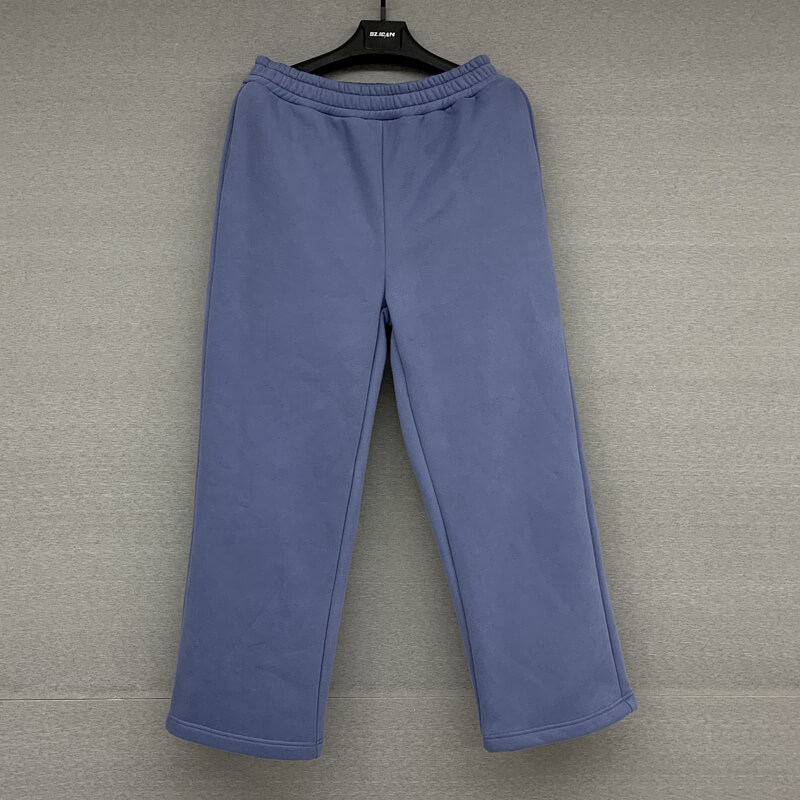
Athleisure brings unique challenges. Achieving the perfect flared sweatpants fit requires strict textile standards. High-quality pieces must utilize heavy-weight fleece or French terry cloth weighing at least 300 GSM.
This heavy weight provides necessary gravity. It forces the fabric to pull downward, maintaining the flared structure. Thin jersey fabrics fail completely in this silhouette. Lightweight materials cling persistently to the knee and collapse inward at the hem. Instead of projecting a deliberate, elevated style choice, thin fabrics result in a sloppy, pajama-like appearance.
Key indicators of quality athleisure flares include:
A reinforced, contoured waistband to prevent sagging.
Heavyweight fabric (300+ GSM) to anchor the hem.
Double-stitched side seams to enforce the A-line structure.
Adequate length to graze the top of platform sneakers.
Mass-market manufacturing heavily favors the statistical average. Standardized sizing grades height and width simultaneously. If you require a wider hip measurement, manufacturers automatically assume you also possess a longer leg. This creates a nightmare scenario for buyers who fall outside standard proportions.
When you size up to accommodate curves, you inherit a longer inseam by default. This drops the knee-break below your actual knee, ruining the geometry. When you hem standard pants to fix the length, you often chop off the widest part of the flare, inadvertently converting them into straight-leg trousers. Off-the-rack sizing forces unacceptable compromises.
Investing in custom flared sweatpants entirely eliminates these systemic fit risks. Custom manufacturing successfully isolates your waist and hip measurements from your inseam measurements. You can specify a generous hip allowance while maintaining a perfectly tailored 28-inch inseam. This guarantees the fabric breaks exactly at your anatomical knee, preserving the intended design.
Use this logical framework to decide between off-the-rack and made-to-measure options:
Choose off-the-rack: If your body aligns closely with standard inseam brackets (typically 30" or 32") and you possess an average hip-to-waist ratio.
Choose custom sizing: If you measure under 5'4" or over 5'9". Petites avoid dragging hems, while tall individuals prevent awkward ankle-grazing lengths.
Choose custom sizing: If you possess a highly pronounced hourglass or pear shape. Custom fits prevent lower-back gapping while accommodating the thigh properly.
The ultimate success of a flared silhouette relies far less on your inherent body shape and heavily on the precise execution of proportions. When the waist rise complements your torso and the fabric breaks precisely at your anatomical knee, flares universally flatter the human form. Achieving this balance requires strict attention to inseam lengths and fabric weights.
Before making a purchase, always measure your exact waist-to-knee and inseam lengths. Compare these numbers rigorously against product size charts. Demand heavyweight fabrics for athleisure styles to maintain structural integrity. Finally, if you fall outside standard height or proportion brackets, confidently opt for custom manufacturing to eliminate frustrating fit guesswork once and for all.
A: Yes. Petite women easily wear flares by utilizing high-waisted cuts to elongate the leg line visually. Matching the pant color to your footwear creates a continuous vertical line. Most importantly, ensure the flare starts precisely at the anatomical knee rather than the calf, preventing the fabric from swallowing your frame.
A: No. Wide-leg fits drape loosely straight down from the hip or upper thigh. Flares remain intentionally restrictive and tailored through the thigh and knee, aggressively widening only at the bottom. They serve entirely different stylistic purposes and require different top-half pairings.
A: Flared sweatpants should fall exactly 1/4 to 1/2 inch off the ground. They must gracefully graze the top of your chosen shoe without ever dragging on the floor. This exact length prevents fabric fraying while maintaining an unbroken, aesthetically pleasing leg line.


