Views: 0 Author: Site Editor Publish Time: 2026-08-04 Origin: Site
The transition from sourcing wholesale blanks to developing custom cut-and-sew apparel exposes brands to complex unit economic realities, particularly with specialized silhouettes like flared bottoms. Brand owners frequently underestimate the hidden production costs associated with non-standard fits, resulting in compressed profit margins or compromised garment quality during the manufacturing phase. A granular breakdown of how specific design choices—from fabric yield and pattern grading to hardware and wash treatments—directly dictate the final landed cost per unit. When you move away from standard joggers, every inch of added fabric changes the marker efficiency on the cutting table. Grading a bell-bottom shape across a full size run requires advanced pattern engineering to maintain the intended knee-to-hem ratio. Hardware additions, specialized waistbands, and heavy-duty stitching further compound the cut-make-trim (CMT) expenses. Understanding these specific manufacturing variables allows you to engineer your garments for better margin control without sacrificing the intended streetwear aesthetic.
Fabric Yield is a Primary Cost Driver: The expanded leg opening of flared silhouettes requires significantly more raw yardage per unit than standard joggers, immediately increasing base material costs.
Weight Equals Expense: Opting for premium, high-GSM fabrics elevates perceived brand value but simultaneously increases both raw material pricing and volumetric shipping costs.
Construction Complexity Multiplies Labor Rates: Non-standard details like split hems, hidden zipper pockets, and custom waistbands require specialized machinery and longer sewing times.
MOQ Dictates Unit Economics: Low Minimum Order Quantities (MOQs) absorb higher setup and pattern-making fees per garment, necessitating strategic pricing models for initial production runs.
Selecting a fabric that holds the structural integrity of the flare without ballooning the base cost per unit requires technical material knowledge. The textile must support the intended drape over footwear while remaining economically viable for bulk production. Fabric choice dictates the physical weight, the shrinkage tolerance, and the overall consumption per garment on the cutting table.
Analyzing the cost delta between standard 300 GSM and premium 400-500+ GSM fleece reveals significant manufacturing variances. Higher fabric density directly impacts knitting time at the mill and raw cotton commodity pricing. When you develop Heavyweight Sweatpants, the increased material thickness requires heavier gauge knitting machines and slower production speeds to prevent yarn breakage. The cutting process also slows down. Standard rotary cutters can slice through 50 plies of thin jersey, but heavy fleece restricts the cutting stack to 15 or 20 plies. This limitation forces the cutting room to perform more passes, increasing labor hours. Furthermore, inbound freight costs rise substantially due to the increased weight and bulk of the finished garments. Shipping containers fill up faster, reducing the total unit count per shipment and driving up the landed cost per piece.
Material composition alters the hand-feel, durability, and manufacturing expense. Using 100% combed cotton offers a premium finish but carries a higher raw material cost due to the combing process that removes short, weak fibers. CVC (Cotton-Rich Blend) or Poly-Spandex blends provide cost-effective alternatives while adding mechanical stretch and structural recovery. The interior finish dictates secondary processing costs. French Terry loops require precise tension control during knitting to maintain loop consistency. Brushed interior fleece involves an extra mechanical process where wire brushes raise the fibers to create a soft nap. This brushing stage adds a fractional premium to the fabric processing cost and creates lint accumulation that factories must manage during the sewing phase.
Calculating the extra fabric yardage required for an expanded bell-bottom or stacked ankle is a primary step in cost engineering. A flared leg opening consumes drastically more material than a tapered jogger. Fabric waste, known as fallout, increases significantly during the cutting process. When nesting flared patterns on a cutting table using CAD software, the irregular, sweeping shapes leave larger gaps of unused fabric compared to straight-leg patterns. Standard joggers might achieve an 85% marker efficiency, meaning only 15% of the fabric is wasted. Flared silhouettes often drop marker efficiency down to 75% or lower. This inefficiency means you pay for raw material that ultimately ends up as scrap on the cutting room floor.
Heavyweight 100% cotton fleece has a notoriously high shrinkage profile, often exceeding 8% if untreated. It carries a tendency to warp flared panel geometries post-wash, causing the side seams to twist around the leg. Managing this requires specific mill-level interventions.
Compacting: The fabric runs through a specialized machine that mechanically compresses the knit structure, reducing length-wise shrinkage.
Double-Shrinking: The mill washes and dries the fabric rolls before cutting, locking in the dimensions.
Pattern Over-Dimensioning: The pattern maker adds the exact shrinkage percentage to the paper pattern, allowing the garment to shrink to the correct spec after the final wash.
Utilizing pre-shrunk fabric carries a premium upfront cost at the mill level. The alternative involves over-dimensioning patterns, which increases the initial fabric yield per garment and complicates the grading process. Over-dimensioning often leads to inconsistent fits across production batches if the shrinkage variance fluctuates between dye lots.
Assessing how upfront development costs translate to a superior, proprietary fit justifies premium retail positioning. A well-engineered pattern separates high-end streetwear from generic merchandise. The initial investment in pattern drafting, block creation, and fit testing pays dividends in customer satisfaction and reduced return rates.
The initial cost of custom pattern drafting is higher than simply modifying an existing factory block. Engineering the "break"—the exact point where the flare hits the shoe—requires multiple sample iterations. Each iteration consumes development time, sample room labor, and courier fees. When designing Wide Leg Sweatpants, the drape must fall perfectly over footwear without dragging excessively on the ground. Achieving the panel insert aesthetic adds further labor. Utilizing multi-panel constructions, side-seam gussets, or triangular contrast panels to achieve a reconstructed look drastically increases cutting and sewing times. A standard sweatpant has four main panels. A reconstructed flare might have eight to twelve panels, doubling the assembly time on the sewing floor.
Grading a flared silhouette is mathematically more complex than grading a standard taper. The flare must not shift out of proportion on larger or smaller sizes. If the grading rules are strictly linear, a size 3XL might end up with a disproportionately massive leg opening that drags on the floor, while an XXS loses the flare effect entirely. Manufacturers charge per-size grading fees to calculate these complex geometric shifts. Offering inclusive sizing from XXS to 3XL impacts upfront development budgets heavily. Each size requires careful adjustment to maintain the intended knee-to-hem ratio. The pattern maker must adjust the grading increments specifically at the knee line and the sweep (hem) independently to preserve the silhouette across the entire size matrix.
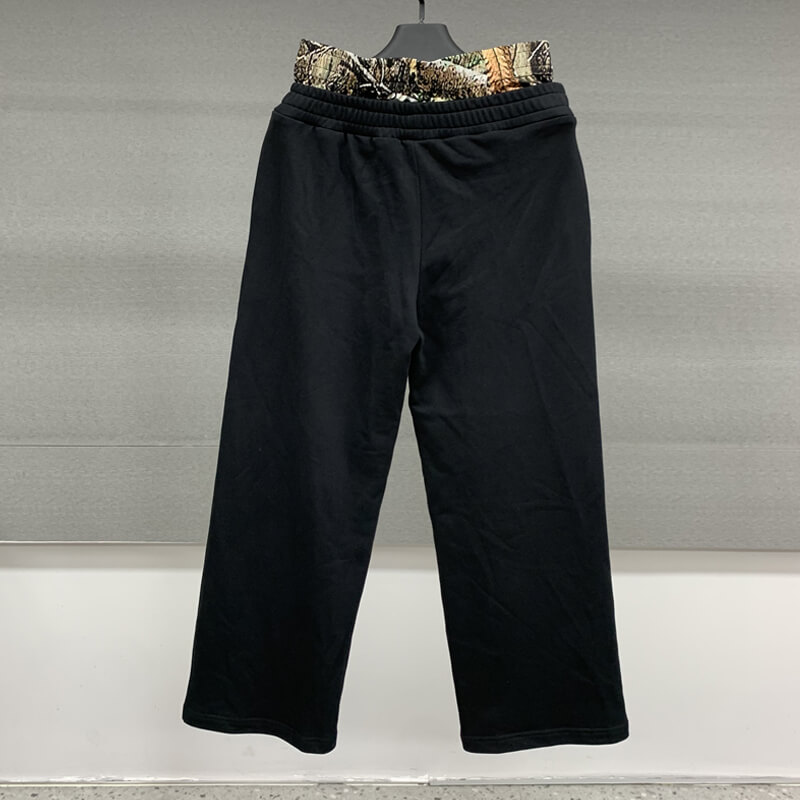
Choosing construction methods that balance durability with manufacturing efficiency is essential for scaling production. Every seam, pocket, and hem choice adds specific labor minutes to the assembly line. These accumulated minutes directly dictate the cut-make-trim (CMT) cost charged by the factory.
Waistband construction varies wildly in complexity and labor requirements. Standard gathered elastic offers a baseline cost and fast assembly using a multi-needle chainstitch machine. Flat-felled waistbands or multi-channel stitching require specialized machinery and precise operator handling to keep the stitch lines perfectly parallel, driving up labor expenses. The choice of drawcord also impacts the assembly line. Inserting extended, heavyweight cotton drawcords requires larger metal eyelets and manual threading through the waistband channel. Standard poly-cords are cheaper and easier to insert using automated pullers, but they lack the premium weight and drape expected in high-end streetwear.
Side-seam slit pockets represent the baseline cost for lower-body garments, requiring minimal cutting and standard overlock assembly. Upgrading to welt pockets or hidden YKK zipper pockets introduces a premium cost due to the precise cutting, folding, and single-needle sewing required. Adding functional cargo pockets to a flared silhouette impacts both labor and material consumption. Cargo pockets require extra fabric yield for the pocket bag and the flap, plus hardware installation for snaps or velcro. They also complicate the side-seam assembly. The operator must stop the overlock machine, align the cargo pocket perfectly on the lateral seam, and secure it before closing the leg, slowing down the overall production line.
The hem is a critical focal point for flared garments. Because the hem interacts directly with footwear and the ground, different finishing techniques carry distinct cost implications and durability factors.
| Hem Construction Type | Labor Complexity | Machine Required | Cost Impact |
|---|---|---|---|
| Raw Edge Hem | Low (Single cut, no folding) | Straight Knife / Rotary | Baseline / Lowest |
| Blind Hem | Medium (Requires folding and guiding) | Blindstitch Machine | Moderate Increase |
| Reinforced Double-Needle | High (Requires folding and precise stitching) | Coverstitch Machine | High Increase |
| Split-Seam with Inner Zipper | Very High (Hardware insertion, extra seams) | Single Needle & Overlock | Premium / Highest |
The added labor of inserting inner-ankle zippers, split-seam details, or adjustable hem drawcords significantly elevates the CMT rate. Integrating reinforced double-layered heel guards prevents dragging wear on stacked options. This functional addition requires cutting extra half-moon fabric panels and applying heavy-duty stitching at the back of the ankle, adding several minutes of labor to each unit.
Determining which visible details provide the highest return on investment for customer perception is a strategic balancing act. Embellishments and custom hardware elevate the garment but require careful placement to avoid manufacturing defects and production bottlenecks.
High-density screen printing, puff print, and direct-to-garment (DTG) each carry different setup fees and unit costs. Screen printing requires burning individual mesh screens for each color, making it cost-effective only at higher volumes. Puff print requires specific curing temperatures in the dryer tunnel to activate the foaming agent without scorching the heavy fleece. Embroidery costs rely heavily on stitch count and digitizing fees. Placement dictates pricing just as much as the method. The seam-crossing cost premium is a major factor in flared pants. Printing or embroidering across lateral flare seams or panel joins increases complexity. It requires precise alignment on the platen and results in higher defect rates during quality control, as the ink or needle must navigate the bulky seam allowance.
The unit cost additions of custom hardware quickly accumulate on the Bill of Materials (BOM). Branded metal aglets, embossed eyelets, and custom woven labels require specialized sourcing and separate minimum order quantities from trim suppliers. Silicone patches need heat-press application or perimeter stitching using a programmable pattern tacker. Each piece of hardware adds a fractional material cost and a specific labor step on the finishing floor. When producing Custom Flared Sweatpants, coordinating these trims ensures a cohesive brand identity but requires strict inventory management at the factory level to prevent production delays caused by missing aglets or labels.
Piece-dyeing fabrics before cutting offers color consistency across the entire production run. Garment-dyeing finished pieces provides a vintage, washed-down aesthetic but increases the risk of uneven shrinkage and color shading between different sizes. Specialty washes like acid wash, enzyme wash, or stone wash attach a premium to the final cost. These processes require industrial washing machines, specific chemical agents, and extended processing times. They also impact fabric integrity and increase fallout rates due to damages or holes created during the aggressive wash cycle. Manual hand-destruction, such as pocket edge grinding using a Dremel tool or micro-distressing at the hem, replicates high-end aesthetics. This manual labor is time-intensive, highly variable, and requires skilled operators to ensure the distressing looks natural rather than uniform.
Geographic manufacturing choices and order volumes dictate the overarching financial structure of your production run. Balancing lead times, freight logistics, and unit costs requires careful factory vetting and a clear understanding of your supply chain capabilities.
Domestic production in the USA or Europe features higher Cut-Make-Trim labor rates due to local wage laws and overhead costs. However, it offers lower shipping costs, faster turnaround times, and reduced import duty liabilities. Domestic factories allow for easier on-site quality control inspections. Overseas production in Asia or South America provides lower CMT and fabric costs due to vertical integration and lower labor rates. The trade-off involves higher minimum order requirements, complex customs procedures, and substantial ocean or air freight charges. Brands must weigh the upfront unit cost savings against the logistical complexities and longer lead times associated with importing heavy fleece garments.
Factories charging for 30-50 piece runs inherently build setup inefficiencies into the unit price. Marker optimization losses, machine calibration time, and screen setup fees are distributed across fewer garments, causing the per-unit cost to spike. Economies of scale become apparent at specific thresholds. Price breaks are typically seen at 100, 300, and 500+ units. Larger runs allow factories to optimize fabric cutting by stacking more plies, streamline the sewing line by assigning operators to single repetitive tasks, and negotiate better raw material yields from the textile mills.
Budgeting for tech packs, initial fit samples, and pre-production (PP) samples is non-negotiable. Skipping these steps leads to bulk production errors that cannot be reversed once the fabric is cut. Mitigating risks requires mandating shrinkage testing and wash testing during the sampling phase. You must verify how the fabric behaves, how the flare drapes, and how the hardware holds up before authorizing a full production run. This upfront investment in prototyping prevents catastrophic losses later in the manufacturing cycle and ensures the final bulk delivery matches the approved standard.
Finalize a comprehensive tech pack detailing exact GSM, knee-to-hem ratio measurements, and hardware specifications before requesting factory quotes.
Request a transparent Bill of Materials (BOM) and a breakdown of cut-make-trim (CMT) costs to identify pricing inefficiencies in your design.
Mandate physical shrinkage and wash testing on the exact bulk fabric during the prototyping phase to secure the structural integrity of the flare.
Standardize internal hardware choices across multiple silhouettes to consolidate trim orders and negotiate better rates with suppliers.
A: Production costs vary widely based on order volume, fabric weight, and manufacturing origin. Domestic small-batch runs carry premium unit costs due to high labor rates. Overseas production offers lower unit costs but requires higher minimum order quantities and incurs significant freight and import duties.
A: Flared silhouettes require significantly more fabric yardage per unit. The expanded leg opening creates irregular pattern shapes, leading to higher cutting waste. Additionally, complex pattern grading and multi-panel inserts require more labor and specialized engineering compared to standard tapered joggers.
A: The ideal range for heavyweight fleece is between 350 and 500 GSM. This density provides excellent structural integrity, allowing the flare to drape properly over footwear without collapsing. However, higher GSM fabrics increase raw material expenses and shipping weights.
A: Yes. Low minimum order quantities force factories to distribute fixed setup fees, pattern making, and machine calibration costs across fewer garments. Larger production runs allow for marker optimization and streamlined assembly, which drives down the individual cost per unit.
A: Standardize your hardware choices and utilize factory-available fabric colors instead of custom Pantone dyeing. Place graphics and embroidery away from seams to reduce defect rates. Simplifying the hem construction and pocket configurations also lowers cut-make-trim labor costs.
A: A complete tech pack must include detailed technical flat drawings, exact fabric composition, and hardware specifications. Crucially, it needs precise Points of Measure (POMs) focusing on the knee-to-hem ratio to ensure the flare grades correctly across all sizes.
A: Domestic manufacturing offers faster turnaround times, lower shipping costs, and easier quality control, making it ideal for low MOQs. Overseas production provides significant savings on labor and raw materials for large volume orders, despite longer lead times and complex freight logistics.


